Energy Monitoring Smart Plug Accuracy
Energy monitoring smart plug accuracy refers to how closely a smart plug’s reported electricity measurements represent the actual power use of a connected appliance. The accuracy of these measurements can depend on factors such as the type of appliance load, measurement method, and reporting process. For an overview of these devices, see energy monitoring smart plugs.
Energy monitoring smart plugs can provide useful measurement information through values such as wattage and kilowatt-hour (kWh) usage, but accuracy should be understood as a conditional measurement topic rather than a fixed outcome. Reported values may vary depending on how measurements are collected, how the connected appliance behaves, and how the energy data is presented.
Evaluating measurement confidence involves understanding different parts of the measurement process, including power readings, voltage and current measurements, accumulated energy reporting, and comparisons with reference measurements. These conditions help define where plug-level energy monitoring can provide useful insight and where reported values may require careful interpretation.
What Accuracy Means for Energy Monitoring Smart Plugs
Energy monitoring smart plug accuracy is the closeness between the electricity use measured by a smart plug and the value reported through its monitoring system. The reported value represents measured appliance electricity use, while the level of accuracy can depend on factors such as sensor quality, calibration, appliance load, and the reporting method.
Accuracy in energy monitoring smart plugs describes how a measured value relates to a reported value rather than representing a fixed precision level for every situation. A smart plug may provide useful household energy estimates, while precision measurement or billing-grade measurement may involve different measurement requirements and reference methods.
To understand the type of information an energy monitoring smart plug records, see what smart plugs measure. This distinction helps separate plug-level energy data from other measurement approaches without treating one method as a universal replacement for another.
How Smart Plugs Measure Power and Energy Use
Energy monitoring smart plugs measure power and energy use by capturing electrical information from a connected appliance and converting that information into displayed energy data. The measurement process connects electrical inputs such as voltage and current with reported values such as power, watts, and kilowatt-hours (kWh).
A smart plug reports electricity use by processing measured values into information that can be viewed through its monitoring system. Power represents electrical demand at a specific moment, while energy data such as kWh represents accumulated usage over time.
How Smart Plugs Measure Power and Energy Use depends on the relationship between electrical input, calculation, and reporting. The way a smart plug samples, calculates, and displays values can influence how the reported energy data should be interpreted for different appliance loads.
| Measurement Input | Reported Data |
|---|---|
| Voltage and current | Power readings such as watts |
| Power over time | Energy totals such as kWh |
This measurement flow separates instant power readings from accumulated energy reporting and shows how electrical inputs become the usage information displayed by an energy monitoring smart plug.
Real-Time Wattage Readings
Real-time wattage readings show the current power draw of a connected appliance at a specific moment. An energy monitoring smart plug displays wattage as an instant power reading, helping users understand how much electrical power an appliance is using at that point in time.
Real-time wattage readings can fluctuate when appliance state changes or when measurement updates occur. A device that increases or reduces its power demand may show changing wattage values, and refresh intervals can affect when those changes appear on the display.
- Appliance state: Changes in appliance operation can affect the displayed power draw.
- Refresh interval: Update timing can influence when wattage changes appear.
- Power fluctuation: Temporary changes in demand can create varying readings.
Kilowatt-Hour Totals Over Time
Kilowatt-hour totals show accumulated energy use over time by summarizing how much electricity a connected appliance has used during a measurement period. An energy monitoring smart plug reports kWh as a cumulative energy value, which differs from wattage readings that represent power use at a specific moment.
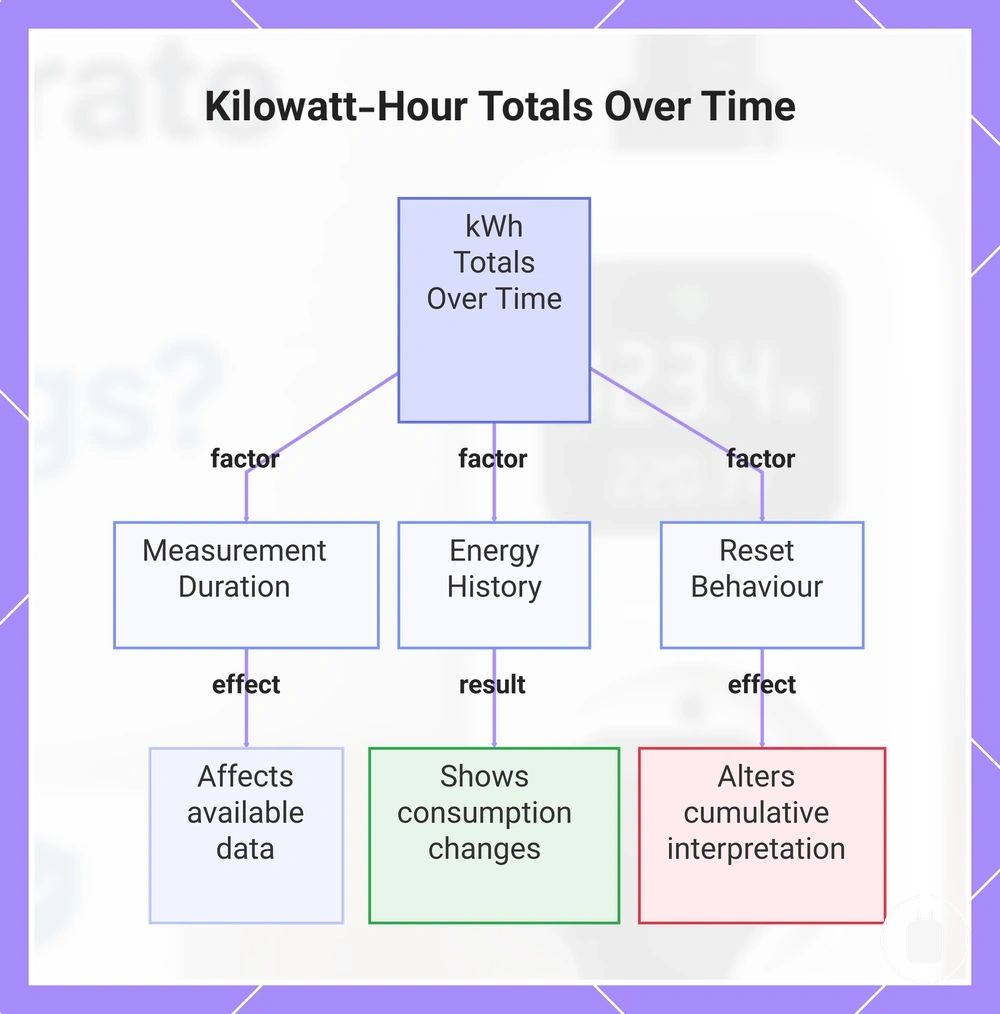
Kilowatt-hour totals depend on how energy data is recorded, stored, and interpreted over time. Factors such as measurement duration, logging continuity, and reset behaviour can influence how cumulative usage history is understood, so kWh values should be viewed as reported energy data rather than an automatic match for electricity bills or meter readings.
Kilowatt-Hour Totals Over Time can be understood through the conditions that influence cumulative energy reporting:
- Duration: The measurement period can affect how much accumulated energy data is available for interpretation.
- Energy history: Recorded usage patterns can help show changes in appliance electricity consumption over time.
- Reset behaviour: Changes to stored readings can affect how cumulative totals are interpreted.
This chart shows the main factors that influence how cumulative kilowatt-hour totals from an energy monitoring smart plug are understood.