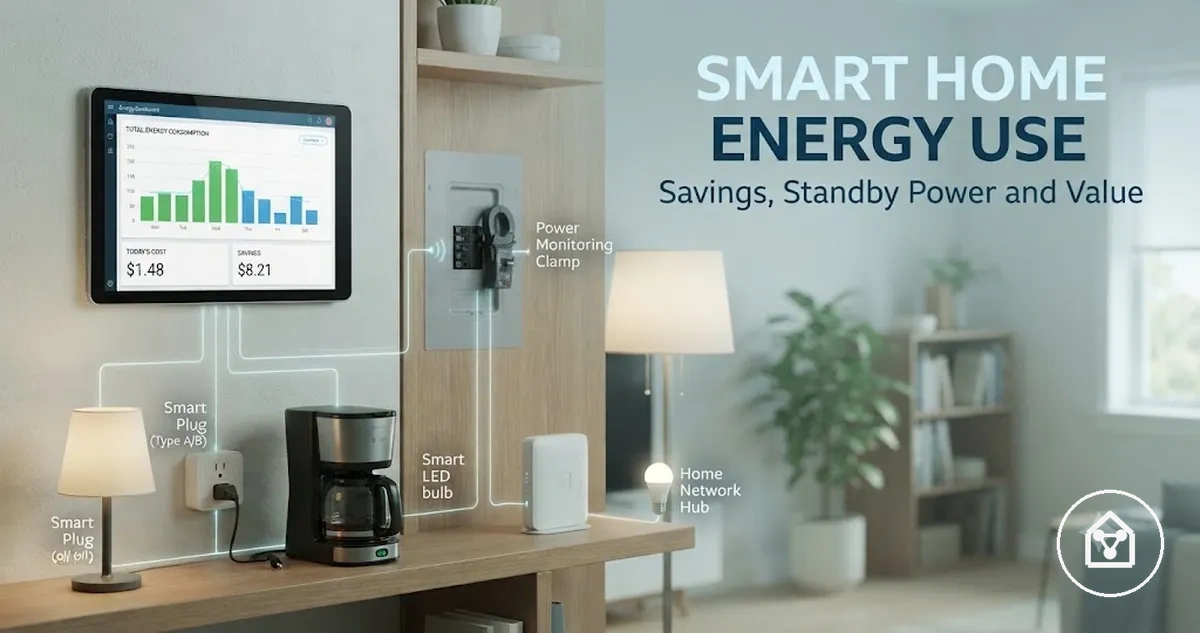
Smart Home Devices, Energy Use, and Savings
Smart home devices are connected devices that use electricity to monitor conditions, control equipment, or automate household actions. Their energy use includes the electricity required for the device itself, standby power while remaining connected, and the controlled load they influence. Energy savings depend on device type, automation quality, household habits, and the electricity use being managed.
Energy savings depend on device type, automation quality, household habits, and the electricity use being managed.
Smart home devices can support energy savings when they change how electricity is used, such as adjusting heating schedules, controlling appliance runtime, or providing energy measurements. An energy monitor can show usage data, while energy reduction requires a separate action such as changing settings, applying automation schedules, or controlling an appliance load.
Energy use in a smart home is shaped by standby power, controlled load, automation, and running cost.
Energy use in a smart home is shaped by standby power, controlled load, automation, and running cost. A smart plug can measure or control a connected appliance load, while a thermostat can adjust heating or cooling behaviour through schedules and temperature settings. For example, a smart plug may reveal that an appliance uses electricity during idle periods, but reducing that waste requires changing when or how the appliance operates.
The value of smart home devices comes from the relationship between electricity measurement, automation, and household behaviour.
The value of smart home devices comes from the relationship between electricity measurement, automation, and household behaviour. Some devices primarily provide visibility into energy use, while others can influence energy consumption through control actions, so evaluating their value requires looking at the specific load and usage pattern involved.
Table of Contents
How Smart Home Devices Use Electricity
Smart home devices are connected devices that use electricity for sensing, communication, control, or automation. Their power draw comes from functions such as collecting sensor data, maintaining network communication, operating control relays, or managing connected equipment. The main power-use modes include sensing, communication, control, battery operation, and mains-powered operation.
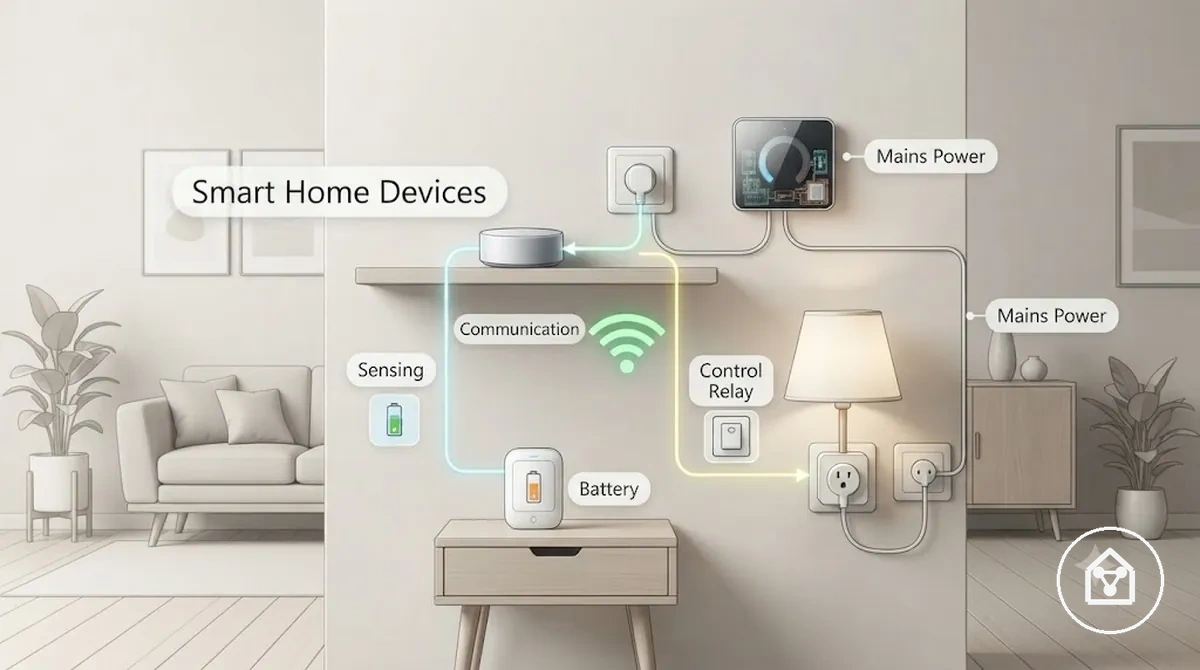
smart home devices hub pages provide broader context for how connected devices operate within a home system. Smart home devices use electricity differently depending on their components: sensors use power to detect conditions, communication components use power to exchange data, control relays use power to switch connected loads, and the device may operate through a battery or a mains-powered connection.
smart home devices hub pages provide broader context for how connected devices operate within a home system.
How Smart Home Devices Use Electricity can be understood through the main ways connected devices consume power:
- Sensing: Sensors use electricity to detect conditions such as motion, temperature, light, or contact status before sending or processing information.
- Communication: Communication components use electricity to transmit data between the device, hub, router, or connected application.
- Control: Control relays use electricity to switch or manage connected equipment when automation rules or user commands are applied.
- Battery operation: Battery-powered smart home devices use stored electricity and may enter lower-power states when active sensing or communication is not required.
- Mains-powered operation: Mains-powered smart home devices use a continuous electrical connection for functions that require ongoing availability, such as hubs, displays, or control systems.
Electricity use does not determine whether a smart home device increases or reduces household energy use by itself. For example, a low-power sensor may only activate sensing and communication functions when needed, while a thermostat or smart plug controlling an appliance load can influence when electricity-consuming equipment operates. This distinction prepares the reader for standby power, where the device's own power use and the load it controls must be considered separately.
Standby Power and Phantom Load in Smart Homes
Standby power is the electricity a connected device or controlled appliance uses while waiting, sensing, or staying network-ready. In smart homes, standby power is conditional because the amount of idle power depends on the device type, operating state, and functions that remain active. Phantom load refers to this idle electricity use when equipment stays connected but is not performing its main active task.
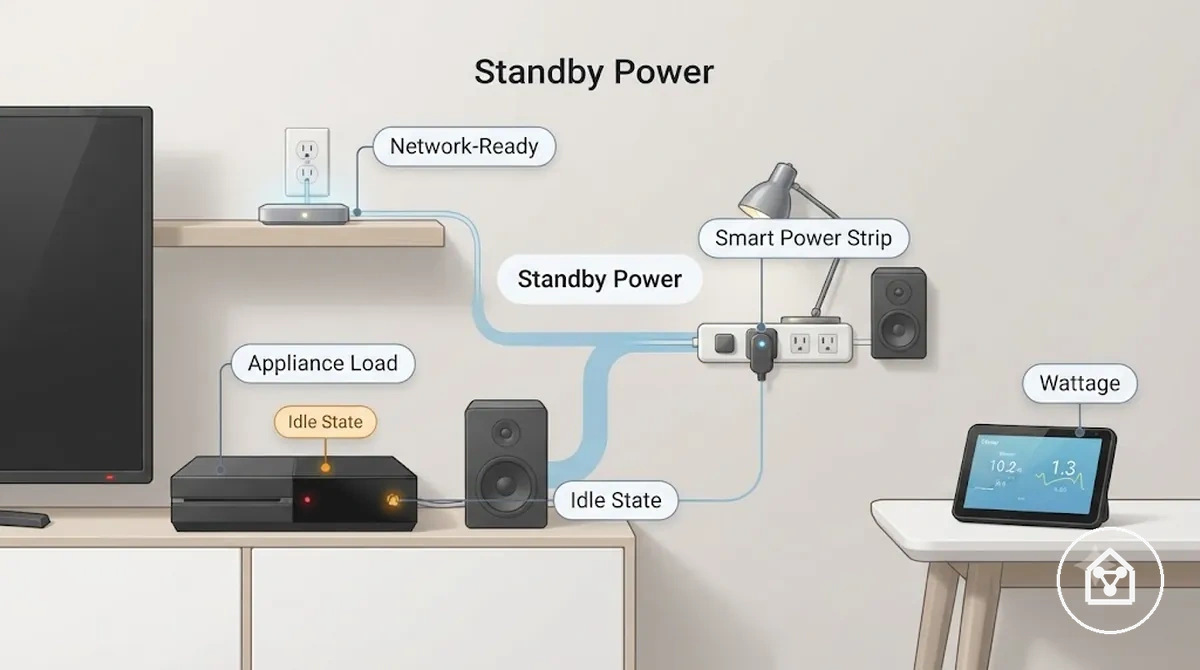
Smart home devices and appliances have different standby conditions because their electrical roles are different. An always-on, network-ready device may use electricity for communication or control functions, while an appliance connected through a controlled outlet may create a larger standby draw that requires wattage monitoring to understand its running cost or waste risk.
Smart home devices and appliances have different standby conditions because their electrical roles are different.
Standby Power and Phantom Load in Smart Homes can be organised by device category, standby condition, possible effect, and monitoring need:
| Device or appliance | Standby condition | Possible effect | What to check |
|---|---|---|---|
| Smart home device | Always-on or network-ready state | Low standby draw for communication, sensing, or control functions | Check standby wattage and active features |
| Connected appliance | Idle state while remaining connected to electricity | Potential phantom load from appliance electronics | Check appliance wattage and required operating state |
| Device group using a smart power strip | Controlled outlet state for connected equipment | Possible standby reduction when suitable idle loads are controlled | Check which devices require continuous power before changing outlet control |
The standby draw of a smart home device should be considered separately from the standby load of an appliance it controls. For example, a network-ready sensor may use electricity to maintain communication, while a smart power strip can help manage idle power from connected entertainment equipment when those devices do not need continuous operation. The practical effect depends on the operating state, controlled load, and monitoring conditions.
Energy Monitoring Versus Energy Saving
Energy monitoring shows usage data, while energy saving requires a control action, schedule change, setting adjustment, or behaviour change that reduces unnecessary electricity use. A power monitor provides insight into where electricity is consumed, but the measurement itself does not change the appliance load or operating conditions. The difference is that monitoring creates awareness, while saving requires an action that changes energy use.
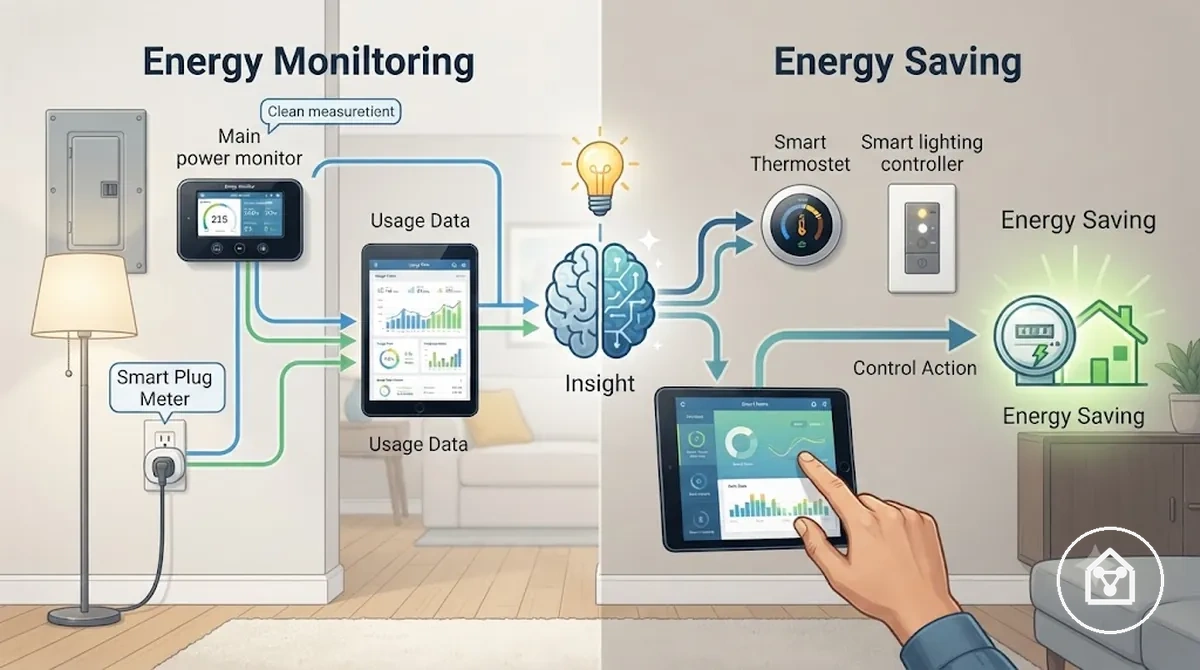
Energy monitoring tools such as a smart plug meter and power monitor measure electricity use, measured wattage, and consumption patterns. An automation rule creates a control action by changing schedules, settings, or device operation, which can turn usage data into a potential reduction outcome through a deliberate decision.
Energy monitoring tools such as a smart plug meter and power monitor measure electricity use, measured wattage, and consumption patterns.
Energy Monitoring Versus Energy Saving can be separated by what each approach does:
| Monitoring does | Saving requires |
|---|---|
| Shows usage data from devices and appliance loads | Changes a control action, schedule, setting, or behaviour pattern |
| Provides insight into measured wattage and consumption timing | Uses that insight to adjust operation or reduce unnecessary runtime |
| Identifies where electricity is being used | Applies an action that can influence the reduction outcome |
A practical case would be a smart plug meter showing that an appliance uses electricity during periods when it is rarely needed. The energy monitoring result provides insight into the load, but energy saving occurs only after a change such as applying an automation rule, adjusting a schedule, or changing the usage behaviour. These decisions also connect to cost and value factors because the usefulness of monitoring depends on whether the information supports a meaningful action.
Smart Home Devices That Can Reduce Energy Waste
Smart home devices can reduce energy waste when they control a meaningful load or reveal avoidable electricity use through measurement. The potential energy effect depends on the device category, control attribute, household condition, and whether the controlled load has an opportunity for reduction. Controlled load matters because a device that only measures electricity provides insight, while a device that changes operation can influence how energy is used.
Different device types and energy use patterns connect to different forms of waste reduction.
Different device types and energy use patterns connect to different forms of waste reduction. A smart thermostat can influence heating and cooling runtime through schedules and occupancy conditions, while a smart plug or meter can identify appliance load patterns that may require a separate control action to reduce wasted electricity.
Smart Home Devices That Can Reduce Energy Waste can be organised by device category, control or measurement attribute, best-fit condition, and likely energy effect:
| Device category | Control or measurement attribute | Best-fit condition | Likely energy effect |
|---|---|---|---|
| Smart thermostat | Heating and cooling schedule control | Homes where temperature runtime can be adjusted through schedules or occupancy patterns | Can reduce unnecessary heating or cooling runtime when settings match household use |
| Smart plug | Appliance load measurement and scheduled control | Connected appliances where usage timing or idle operation can be reviewed | Can support waste reduction by identifying or changing appliance operation patterns |
| Smart power strip | Controlled outlet switching | Device groups with suitable standby loads that do not require continuous power | Can help reduce selected standby loads when outlet control is appropriate |
| Smart switch | Lighting schedule and occupancy control | Rooms where lighting use depends on timing or presence | Can reduce unnecessary lighting runtime through automated control |
| Sensor or meter | Occupancy detection or energy measurement | Homes where usage patterns need to be identified before changing behaviour | Provides insight that can support later control actions or behaviour change |
For example, a smart plug meter may reveal that an appliance remains active during periods when it is rarely used. The measurement does not create energy savings by itself, but it can guide a schedule change, automation rule, or control action that reduces avoidable electricity use when the appliance load allows it.
Smart thermostats and heating control
Smart thermostats can reduce heating or cooling waste by controlling runtime through schedules, setpoint adjustments, occupancy information, and household routines. A smart thermostat does not create savings automatically; the energy effect depends on how the heating or cooling system operates under the selected settings and conditions. Runtime is the main condition because unnecessary operation increases avoidable energy use.
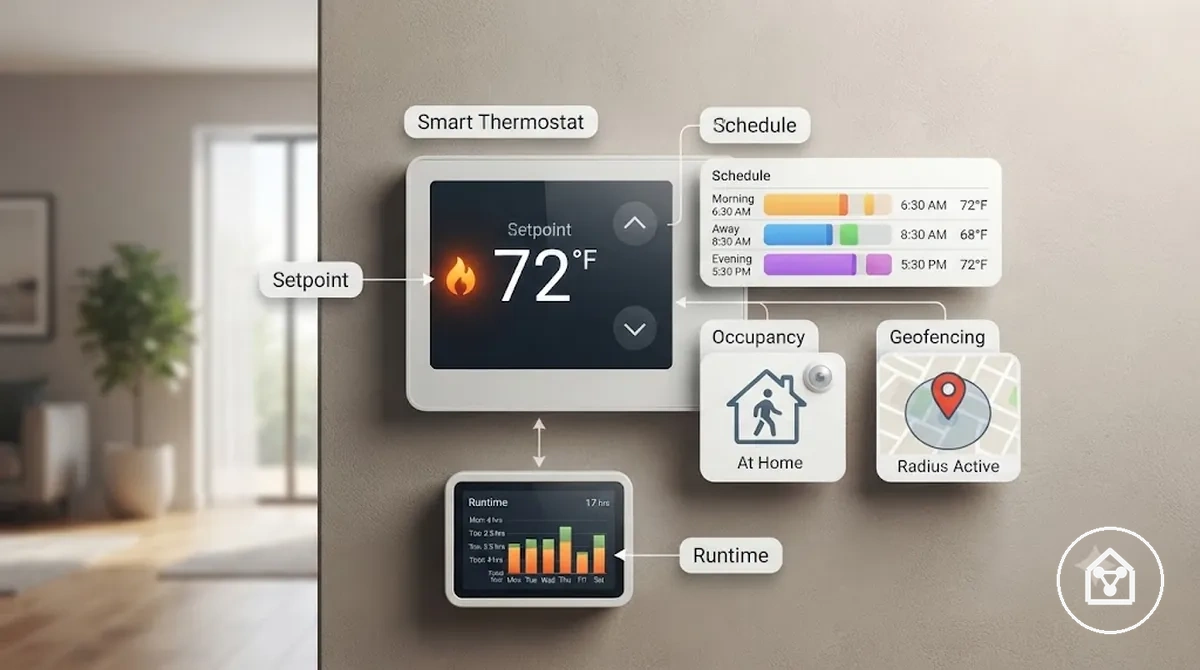
Smart thermostats and heating control use different settings to align temperature control with household needs:
- Schedule: A heating schedule adjusts when heating or cooling operates so runtime can match expected household routines.
- Setpoint: Setpoint control changes the target temperature, influencing when the system starts or stops operation.
- Occupancy: Occupancy sensing uses presence information to support temperature adjustments when rooms are used or unused.
- Geofencing: Geofencing can adjust thermostat behaviour based on location conditions when this feature is configured.
- Manual override: Manual overrides allow comfort changes but may reduce the value of automated control when frequent adjustments conflict with the schedule.
An edge case occurs when a household frequently overrides the thermostat schedule or uses setpoints that do not match its routine. In this situation, the smart thermostat still provides heating control and cooling control features, but the expected savings condition may be reduced because runtime is no longer aligned with the intended household pattern.
Smart plugs, power meters, and appliance control
Smart plugs and power meters help identify or control appliance-level electricity use by measuring wattage, applying schedules, or enabling remote shutoff functions. A smart plug can support appliance control when the connected load is suitable for its intended use, while a power meter can provide measured wattage for diagnosing how an appliance uses electricity. Suitability is the main boundary because appliance condition, load requirements, and manufacturer guidance determine whether a control method is appropriate.
Suitability is the main boundary because appliance condition, load requirements, and manufacturer guidance determine whether a control method is appropriate.
Smart plugs and power meters can be used in situations where appliance conditions make measurement or control useful:
- Entertainment equipment: A smart plug can check measured wattage during active or standby states and apply a schedule or remote shutoff when the appliance condition allows controlled operation.
- Small household appliances: A power meter can show appliance wattage and provide a diagnostic outcome by identifying usage patterns before changing schedules or behaviour.
- Devices with standby waste: A plug-in meter can measure idle electricity use and provide insight into whether standby operation is a potential waste condition.
- Scheduled appliances: A smart plug can apply timed control when the appliance load and manufacturer guidance support scheduled operation.
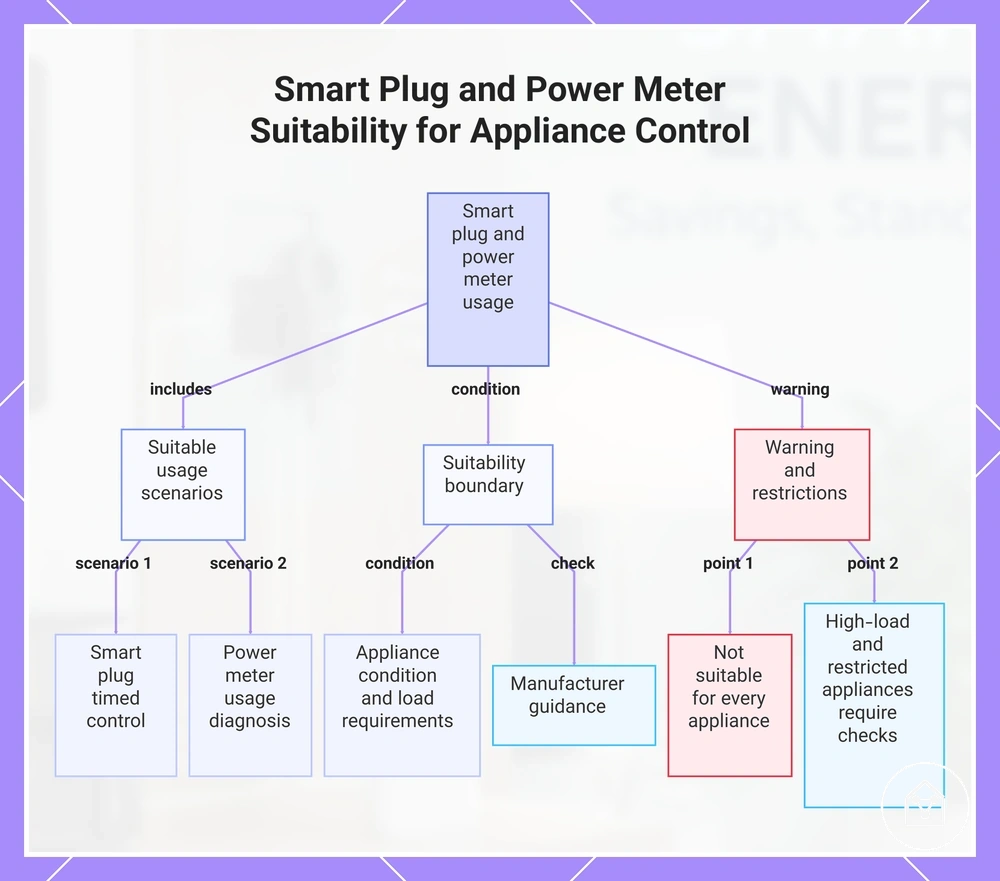
A smart plug or power meter should not be treated as suitable for every appliance. High-load appliances and manufacturer-restricted equipment require suitability checks before using features such as remote shutoff or scheduled control, because appliance safety conditions and load limits determine whether the control method is appropriate.
A smart plug or power meter should not be treated as suitable for every appliance.
This chart shows the main usage scenarios, the suitability boundary, and important warnings for using smart plugs and power meters to monitor or control appliance electricity use.
Smart power strips and standby load reduction
Smart power strips can reduce standby load when they control a suitable device cluster through outlet control, load sensing, timers, or other outlet-level features. The potential standby reduction depends on whether connected devices can be switched without affecting required network functions, clocks, updates, or scheduled operation. Grouped-device fit is the main condition because not every device cluster should lose continuous power.
Grouped-device fit is the main condition because not every device cluster should lose continuous power.
Smart power strips and standby load reduction can be evaluated through these use-case checks:
- Device cluster: Check whether the connected devices share a standby waste condition and whether outlet control can reduce unnecessary idle operation.
- Outlet control: Check whether controlled outlets match the operating state requirements of the connected device cluster before applying standby reduction.
- Timer: Check whether the timer schedule matches periods when the device cluster does not need active power.
- Load sensing: Check whether load sensing can identify changes between active use and standby conditions.
- Surge feature: Check whether the surge feature is relevant to the device cluster while keeping power requirements and operating needs separate from standby control.
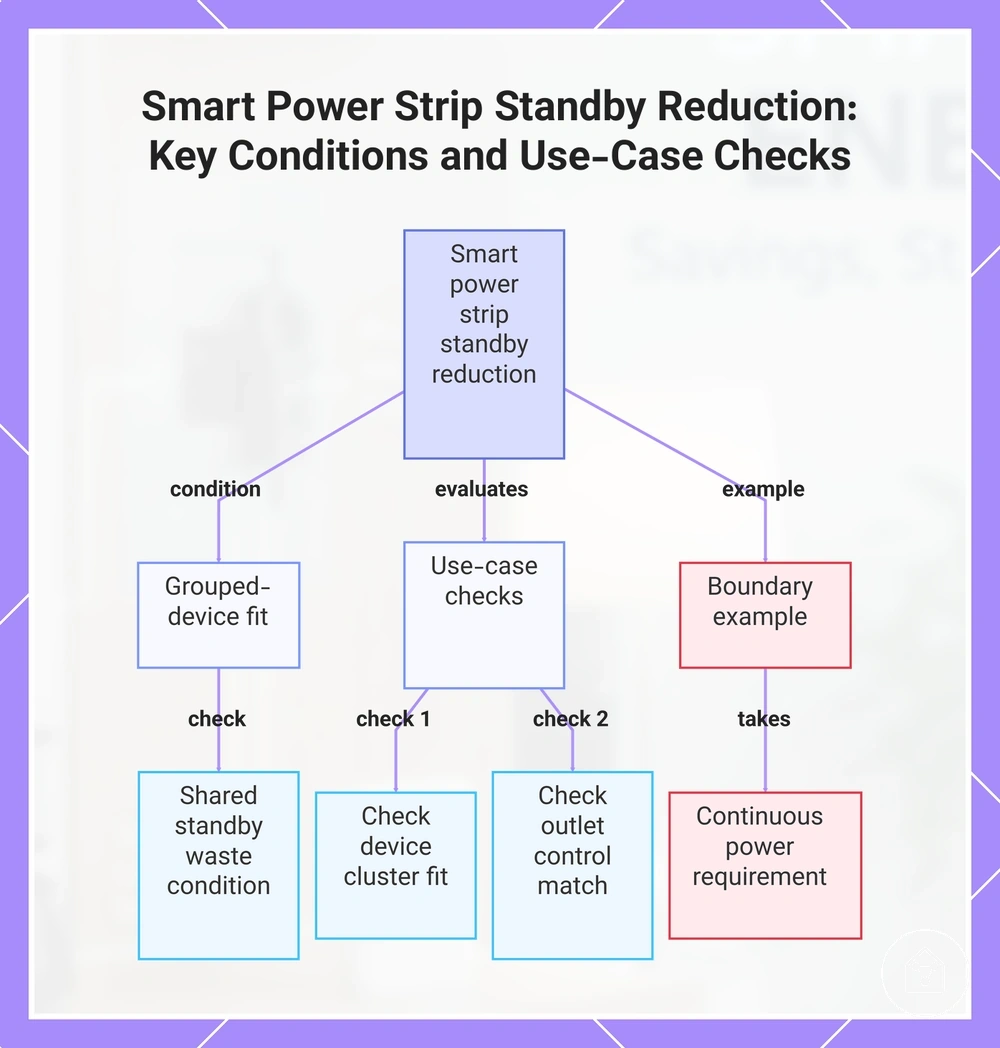
A boundary example is a device cluster that includes equipment requiring continuous power for a network function, clock, update process, or scheduled operation. In this situation, a smart power strip may not be suitable for reducing standby load on every outlet because the stay-powered requirement changes the expected standby reduction outcome.
A boundary example is a device cluster that includes equipment requiring continuous power for a network function, clock, update process, or scheduled operation.
This chart shows the main condition for smart power strip standby reduction, the key use-case checks, and a boundary example where continuous power requirements limit suitability.
Smart switches, lighting schedules, and occupancy control
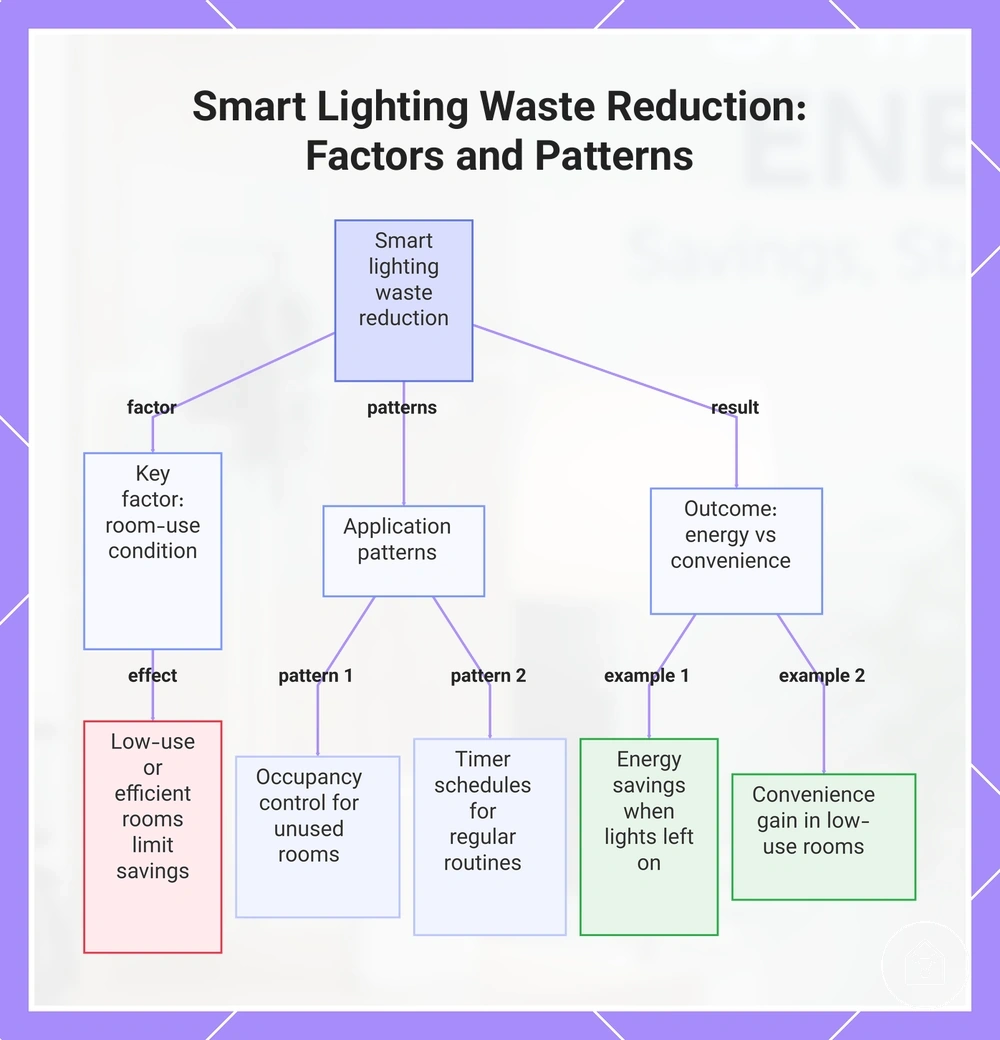
Smart switches can reduce lighting waste when they control lights in rooms where timing, occupancy, or manual habits cause unnecessary operation. Lighting schedules and occupancy control can adjust when lights operate, but the electricity-saving effect depends on room use, existing lighting efficiency, and whether lights are frequently left on when not needed. The room-use condition is the main factor because low-use rooms or already efficient lighting may provide limited reduction potential.
The room-use condition is the main factor because low-use rooms or already efficient lighting may provide limited reduction potential.
Smart switches, lighting schedules, and occupancy control can be applied to different room patterns and timing conditions:
- Unused rooms: Occupancy control can detect when rooms are empty and reduce unnecessary lighting operation when the lighting setup supports automated control.
- Regular routines: A timer or lighting schedule can match operation with predictable room-use periods, reducing lighting waste outside expected use times.
- Variable lighting needs: Dimming control can adjust light output when full brightness is not required, depending on the lighting system and user preferences.
- Manual adjustments: Manual control or overrides allow users to change automated lighting behaviour when actual room use differs from the planned schedule.
Smart switches can provide both energy and convenience value, but these outcomes are not identical. For example, occupancy control in a room where lights are often left on may reduce unnecessary operation, while a low-use room with efficient lighting may gain more convenience than measurable electricity reduction.
Smart switches can provide both energy and convenience value, but these outcomes are not identical.
This chart explains the key factor, application patterns, and value outcomes of using smart switches, schedules, and occupancy control to reduce lighting waste.
Automation Patterns That Affect Energy Savings
Automation rules can influence energy savings by changing when devices run, how long they remain active, and whether they respond to household conditions. The potential outcome depends on the quality of the rule, including its trigger, schedule, and operating conditions rather than the presence of automation alone. Rule quality is the key variable because a poorly designed automation pattern can increase runtime, create waste, or reduce reliability.
Remote control provides an additional decision point when planned automation does not match actual use.
Automation Patterns That Affect Energy Savings connect automation and energy use with triggers and schedules that change device behaviour. A schedule can control runtime based on time, while an occupancy trigger or sensor input can adjust operation when household conditions change. Remote control provides an additional decision point when planned automation does not match actual use.
Automation Patterns That Affect Energy Savings connect automation and energy use with triggers and schedules that change device behaviour.
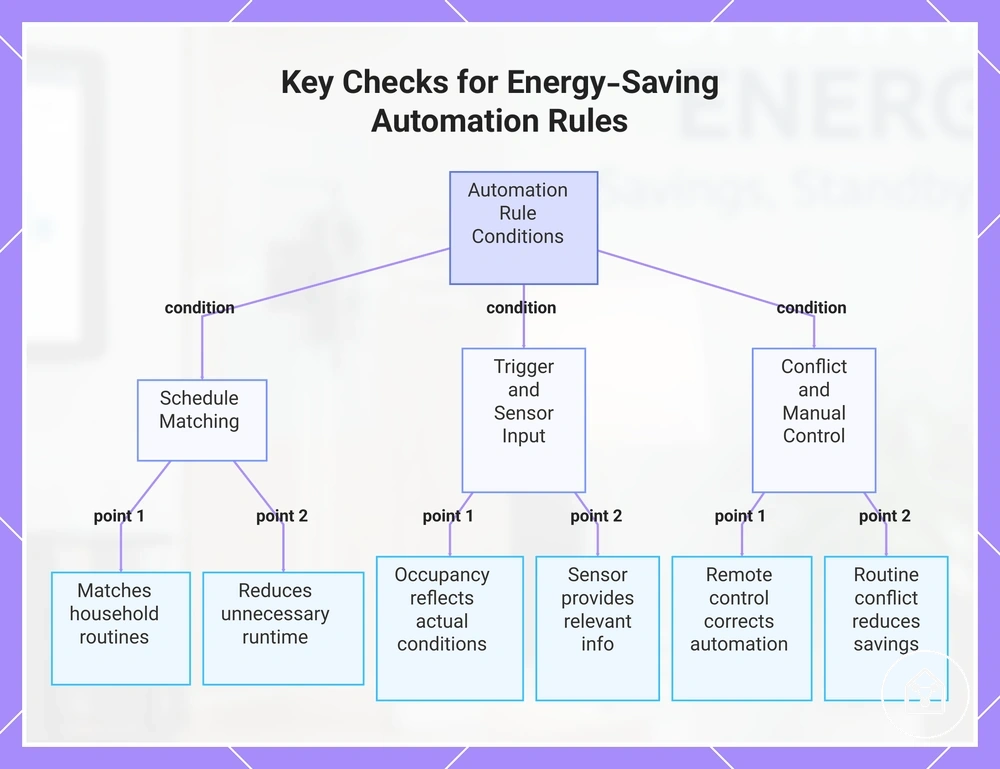
Automation Patterns That Affect Energy Savings can be checked through these rule conditions:
- Schedule: Check whether the timed control matches household routines and reduces unnecessary runtime during periods of low use.
- Occupancy trigger: Check whether occupancy information reflects actual room conditions before changing device operation.
- Remote control: Check whether manual intervention can correct automation when current conditions differ from the planned rule.
- Sensor input: Check whether sensor input provides relevant information for adjusting operation and reducing waste.
- Routine conflict: Check whether household habits conflict with automation rules and reduce the expected savings outcome.
A routine conflict can occur when an automation rule follows a schedule that no longer matches household behaviour. For example, a device may continue running during changed routines, creating unnecessary runtime or reducing the reliability of the automation pattern.
A routine conflict can occur when an automation rule follows a schedule that no longer matches household behaviour.
This chart shows the main rule conditions to check when evaluating whether automation patterns actually save energy.
Schedules, occupancy, and remote control
Schedules, occupancy detection, and remote control create different energy outcomes because each control pattern responds to a different household condition. A schedule uses timing, occupancy detection uses presence, and remote control uses access for manual correction or adjustment. These control patterns work differently depending on routine regularity, detection accuracy, and how devices are operated.
These control patterns work differently depending on routine regularity, detection accuracy, and how devices are operated.
Schedules, occupancy detection, and remote control can be compared by their control conditions and likely energy effects:
- Schedule: A schedule uses timing as the control attribute, which can reduce runtime when device operation matches predictable routines but may have limited effect when household patterns change often.
- Occupancy detection: Occupancy detection uses presence as the control attribute, which can help avoid waste in spaces with irregular use when presence sensing accurately reflects room conditions.
- Remote control: Remote control uses access as the control attribute, allowing manual correction when automation does not match current conditions or when a device needs adjustment outside its planned operation.
For example, a household with changing room-use patterns may benefit from occupancy detection more than a fixed schedule because the control pattern responds to actual presence rather than expected timing. However, occupancy detection is not always the preferred option because the energy outcome still depends on detection accuracy, runtime, and the specific household condition.
Usage habits that increase or reduce savings
Usage habits influence the real outcome of smart home energy features because automation effectiveness depends on how people interact with settings, alerts, and monitoring tools. Behaviour can support savings when it aligns with device operation, but the result depends on household context rather than user fault or a guaranteed result. The impact of these features is therefore shaped by follow-through, including whether habits support or weaken the intended energy control.
The impact of these features is therefore shaped by follow-through, including whether habits support or weaken the intended energy control.
Usage habits can affect smart home energy outcomes through these behaviour conditions:
- Override frequency: Frequent overrides can change planned automation behaviour and create a neutral result or wasted load when settings no longer match actual household needs.
- Schedule discipline: Following planned schedules can support savings by keeping runtime aligned with intended use, while inconsistent changes may reduce the expected effect.
- Alert response: Responding to alerts can help identify conditions that require adjustment, while ignored alerts may limit the value of automation features.
- Monitoring review: Reviewing energy information can support behaviour change by revealing usage patterns, but the outcome depends on whether the information leads to a practical adjustment.
Passive automation and habit-dependent monitoring provide different types of value. For example, passive automation may continue following a rule without regular input, while monitoring review requires follow-through to influence future energy decisions and reduce a potential wasted load.
When Smart Home Energy Savings Create Real Value
Smart home energy savings create real value when the potential energy reduction is meaningful compared with device cost, running cost, controlled load, and use frequency. A device that affects a frequently used or higher-energy load may have stronger value potential, while a device used rarely may provide limited financial impact. The practical value depends on the relationship between cost, savings potential, and household conditions rather than the device category alone.
Device cost and running cost shape the return context alongside the type of load being controlled.
Device cost and running cost shape the return context alongside the type of load being controlled. High-load appliances, heating control, frequent standby waste, and monitoring-led behaviour change create different value conditions because each feature affects energy use in a different way. The usefulness of a device depends on whether the controlled load and usage condition create enough opportunity for meaningful change.
The usefulness of a device depends on whether the controlled load and usage condition create enough opportunity for meaningful change.
When Smart Home Energy Savings Create Real Value can be compared by device or load context, cost factors, savings conditions, and value signals. These criteria also connect to cost and value factors because the outcome depends on upfront cost, ongoing use, and the energy behaviour being influenced.
| Device or load context | Cost factor | Savings condition | Value signal |
|---|---|---|---|
| High-load appliances | Device cost needs to be considered against the controlled load affected | Value potential is stronger when the device influences frequent or energy-intensive operation | Payback direction is more favourable when use frequency and controlled load are high |
| Heating control | Device cost is linked to the ability to influence heating runtime | Energy savings depend on whether operation can match household conditions | Convenience value and energy control may provide practical value together |
| Frequent standby waste | Device cost should be compared with the avoidable standby load being controlled | Standby waste reduction depends on whether the connected load can be adjusted appropriately | Value increases when repeated idle consumption creates a clear control opportunity |
| Monitoring-led behaviour change | Device cost relates to the usefulness of the information provided | Savings depend on monitoring review and whether usage behaviour changes follow | Practical value may come from awareness and decision support rather than direct load reduction |
Decision signals are more useful than product rankings when judging energy value. Consider whether a device affects a high-load appliance, improves heating control, addresses frequent standby waste, or supports monitoring-led behaviour change before estimating the likely outcome.
Decision signals are more useful than product rankings when judging energy value.
The final value judgment depends on household conditions, including use frequency, controlled load, and ongoing interaction with the feature. A device may provide convenience value when financial savings are limited, while another device may create stronger practical value when it influences a frequently used load with clear waste reduction potential.
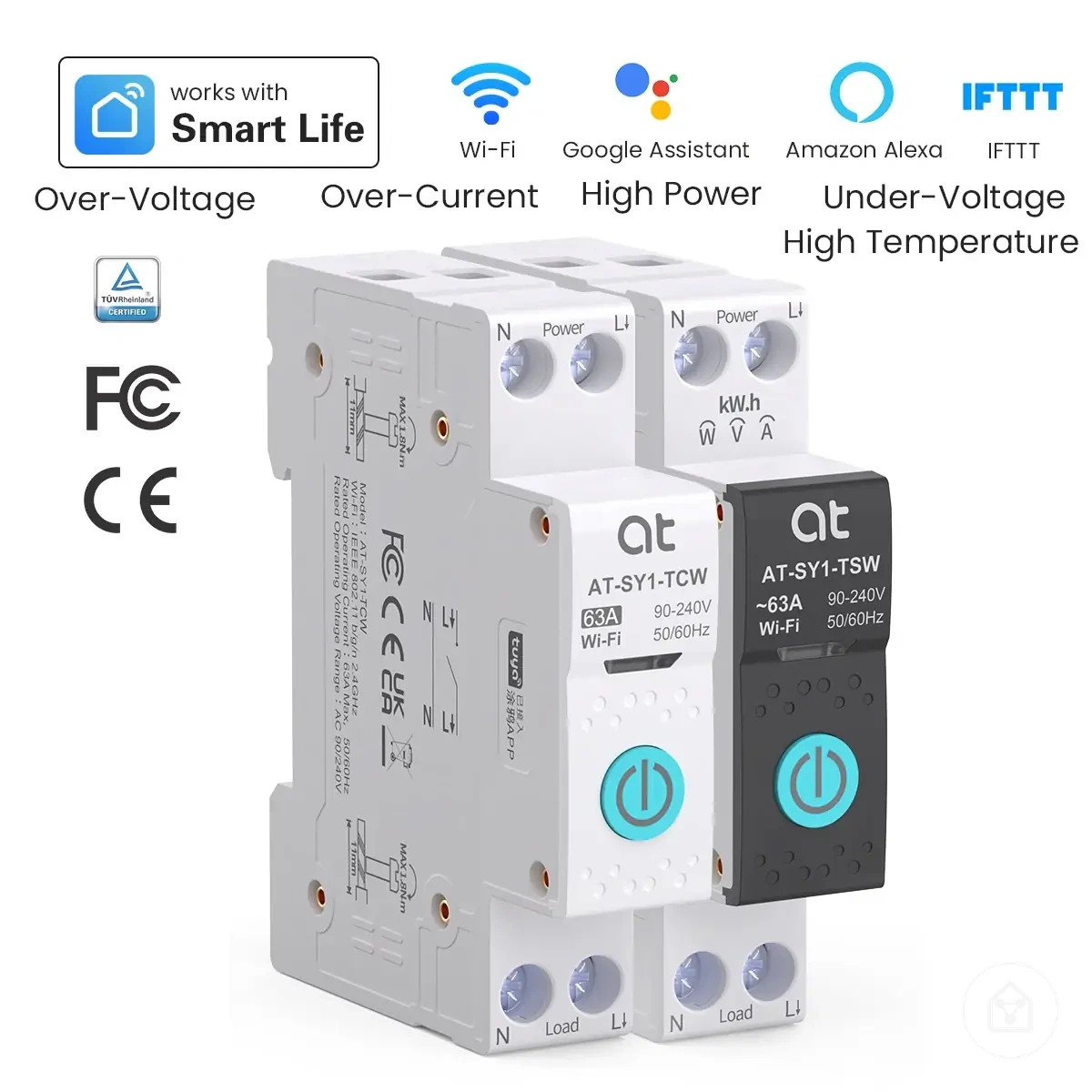
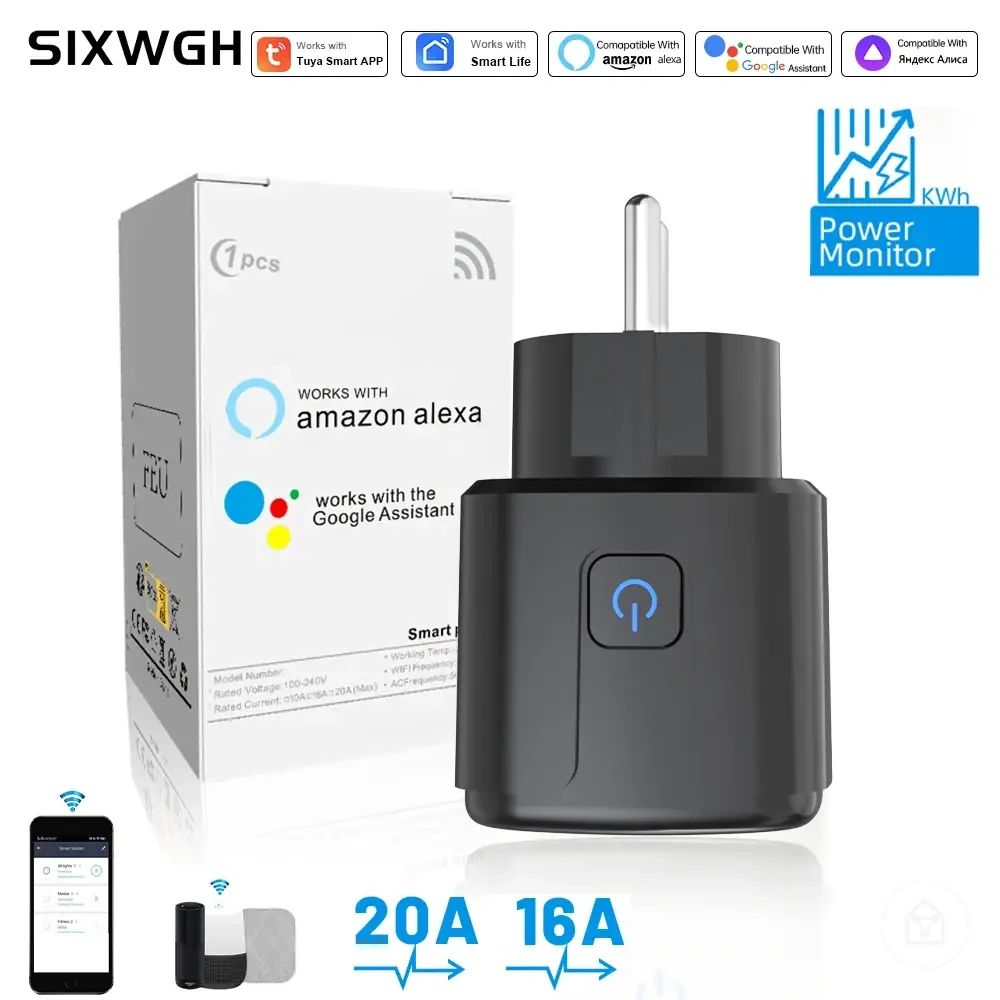
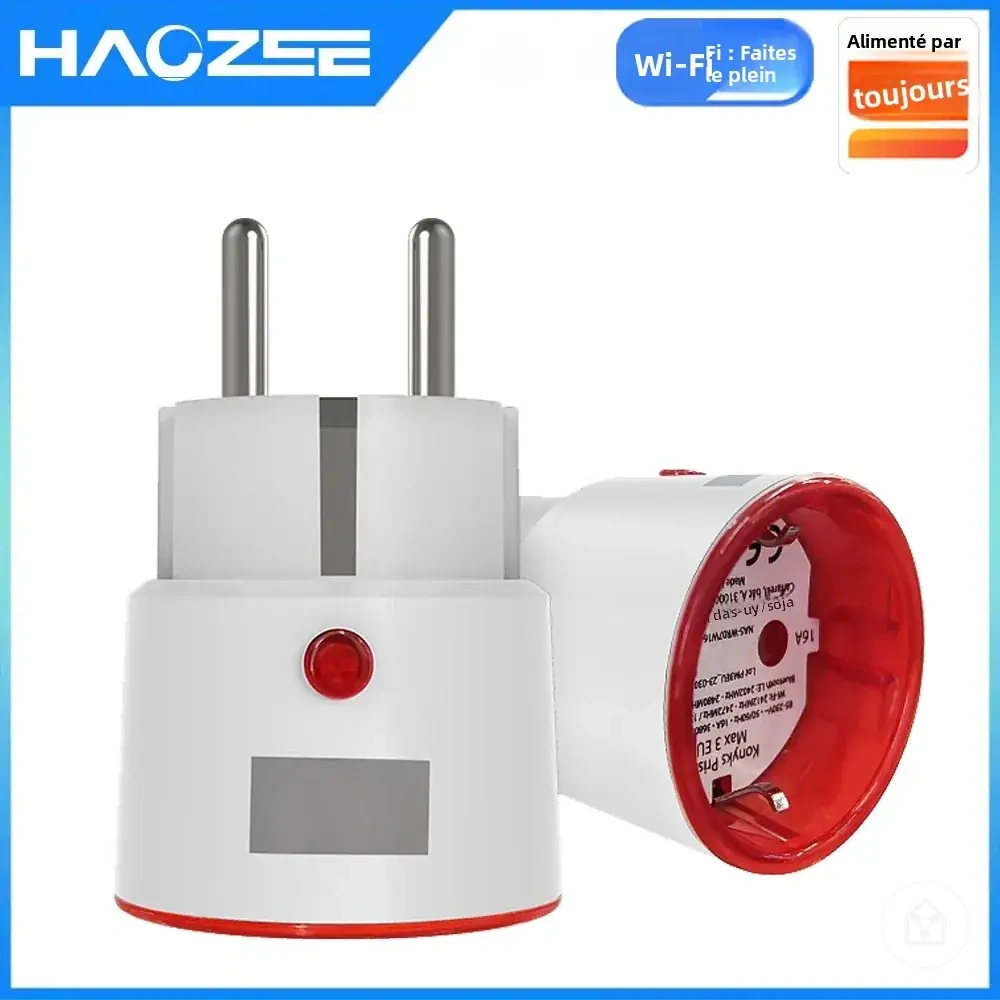
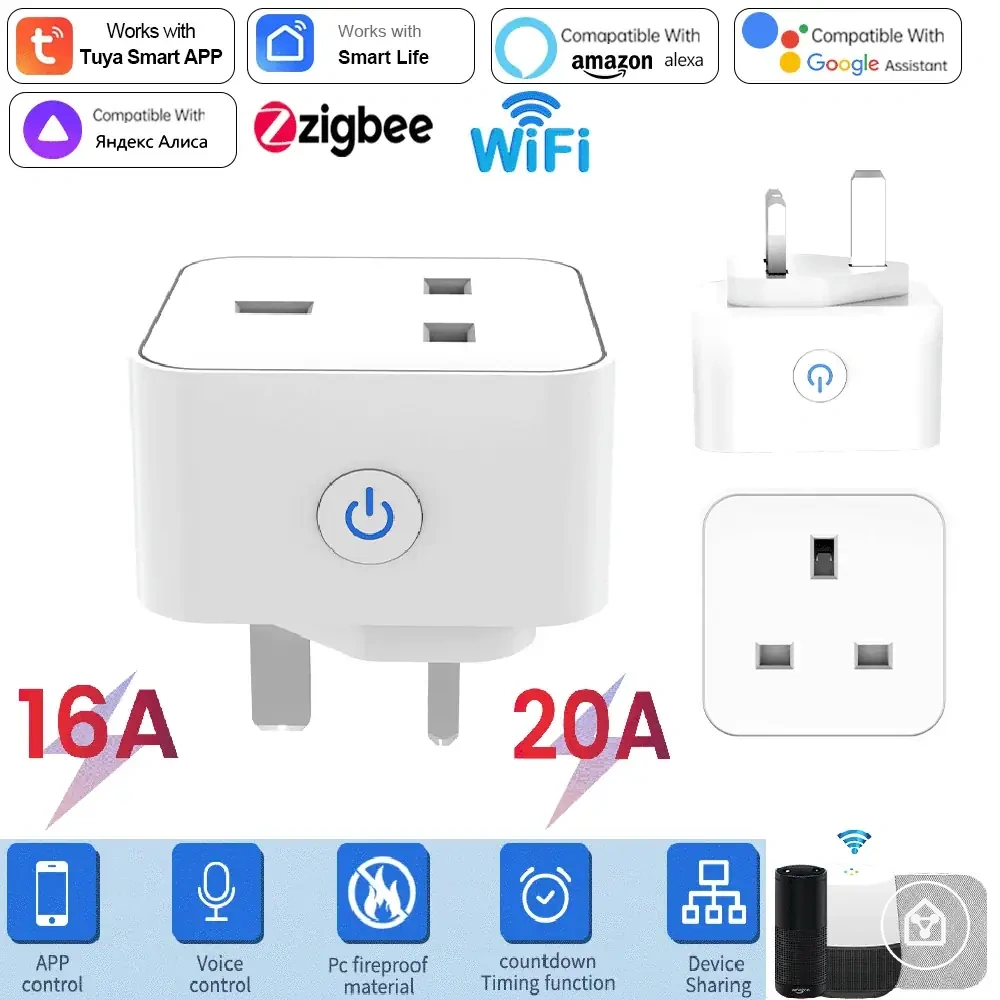
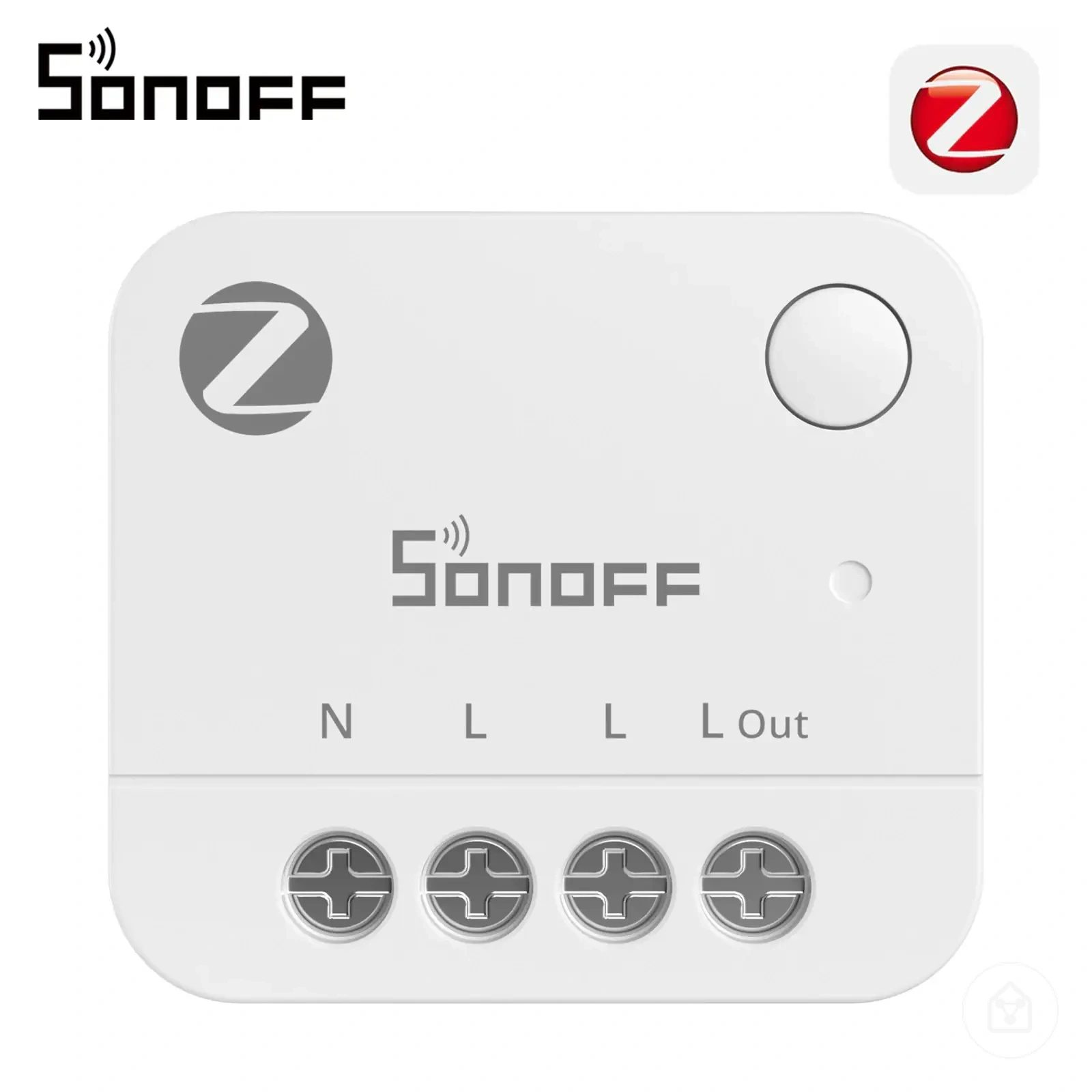
The products below are useful examples for comparing available options.
The products below are useful examples for comparing available options. Before buying, check that the compatibility criteria, key features, and product details match your needs.
Device cost, running cost, and payback context
Device cost, running cost, and payback context should be evaluated through assumptions because energy value depends on purchase cost, operating draw, appliance load, and use frequency. A device may have stronger payback direction when it influences a frequently used or higher-energy load, while a lower-use application may provide more convenience value than direct energy savings. Payback is therefore an assumption-based estimate rather than a universal result.
Payback is therefore an assumption-based estimate rather than a universal result.
Payback thinking compares upfront cost with the ongoing energy effect created by the controlled load. The relationship between device cost, running cost, and controlled-load savings depends on the operating draw of the smart feature, the appliance load being influenced, and how often the device is used.
Payback thinking compares upfront cost with the ongoing energy effect created by the controlled load.
A compact payback context can be organised by changing the assumptions rather than applying a fixed period:
- Device cost: The purchase cost is the starting value that must be balanced against the potential savings created by the controlled load.
- Operating draw: The device's own electricity use contributes to running cost and should be considered when estimating overall value.
- Appliance load: A larger controlled appliance load may create more opportunity for savings than a rarely used low-energy load.
- Use frequency: Frequent operation can increase the opportunity for controlled-load savings compared with occasional use.
For example, a smart control feature applied to a frequently used appliance may have a stronger payback direction when the assumptions include meaningful load reduction and regular operation. If the same feature is applied to a rarely used device, the energy payback may be modest, while the convenience value may still support the decision.
Household conditions that change savings potential
Household conditions that change savings potential determine whether smart home energy features have a stronger, weaker, or mostly neutral effect. Savings potential depends on the home's existing loads, habits, and energy-use conditions rather than being the same across every household. Tariff, appliance age, heating demand, cooling demand, occupancy pattern, and standby-heavy areas are key variables that influence the outcome.
Load condition, energy pricing, occupancy, and existing efficiency levels shape how a smart home feature performs in a specific home.
Load condition, energy pricing, occupancy, and existing efficiency levels shape how a smart home feature performs in a specific home. A household with higher heating demand, older appliances, or frequent standby-heavy areas may have more opportunities for control, while an already-efficient household may receive more convenience value than additional energy reduction.
Household conditions that change savings potential can be compared through these criteria:
| Household condition | Why it matters | Savings direction |
|---|---|---|
| Tariff | Energy pricing conditions influence the value of changing when controlled loads operate | Potential value may increase when automation matches suitable usage periods |
| Appliance age | Older appliances may have different operating patterns compared with newer efficient models | Potential value may be stronger when controllable loads include avoidable energy use |
| Heating demand and cooling demand | Temperature-control needs affect how much runtime can potentially be adjusted | Potential value may increase when smart control aligns operation with household conditions |
| Occupancy pattern | Regular or irregular presence affects how well automation matches actual use | Potential value may improve when control responds to real occupancy conditions |
| Standby-heavy areas | Groups of connected devices with repeated idle operation may create control opportunities | Potential value depends on whether standby waste can be reduced without affecting required operation |
Scenario differences help qualify the expected outcome. For example, an apartment with already-efficient appliances may have limited savings potential, while a larger home with higher heating demand may have more opportunities for runtime control. A household with irregular schedules may benefit from responsive automation, whereas an efficient household with low waste may mainly gain convenience value.
Limits of Smart Home Energy Savings
Smart home energy savings have limits because device control can influence runtime, settings, and usage conditions, but the outcome depends on what the device can actually control. Smart devices can create realistic savings when they address a suitable load or reduce avoidable waste, while other situations may produce limited or neutral results. These limits depend on the relationship between device control, appliance efficiency, behaviour, and the automation condition.
These limits depend on the relationship between device control, appliance efficiency, behaviour, and the automation condition.
Smart devices can influence energy savings by changing operation periods, adjusting settings, monitoring usage, or reducing suitable standby load conditions. However, appliance efficiency remains a separate factor because a smart device cannot make an inefficient appliance inherently efficient without changing runtime, settings, or usage behaviour.
| Smart devices can change | Smart devices cannot change by themselves |
|---|---|
| Runtime through schedules, automation, and controlled operation when the automation condition supports it | The underlying appliance efficiency of existing equipment |
| Settings that influence operation, such as temperature targets or operating periods | The energy demand created by household requirements that remain unchanged |
| Standby load conditions when connected devices allow controlled operation | Standby load from devices that require continuous power or active functions |
| Usage awareness through monitoring that supports behaviour change | Behaviour patterns that do not change after information is provided |
A balanced boundary is that smart devices provide useful control rather than replacing appliance efficiency improvements. For example, smart heating control may reduce unnecessary runtime when settings and usage patterns change, but it cannot transform an inefficient heating system into an efficient one without changes to the equipment, settings, or way it is used.
Smart devices that may add electricity load
Smart devices can add their own electricity load while providing control, monitoring, or convenience features. This added load is a value trade-off because a device may use energy for standby draw, communication, display functions, or hub dependency while also influencing how other loads operate. The importance of this added load depends on the operating condition and the balance between device draw and the value provided.
Smart device electricity load is influenced by which functions remain active during operation.
Smart device electricity load is influenced by which functions remain active during operation. Standby draw, communication activity, display use, and hub dependency can affect the device's own power use, creating different outcomes between low-power control devices and devices with screens, hubs, or frequent networked control activity.
Examples of smart device attributes that can affect added electricity load include:
- Always-on hubs: A hub may maintain communication with connected devices, adding a continuous device draw while providing central networked control.
- Smart plugs: A smart plug may add its own standby draw while providing monitoring or switching control for a connected appliance.
- Displays: A device with a display may use additional electricity compared with a simple control device because the screen remains an active function.
- Sensors: A sensor designed for low-power monitoring may have a different electricity load from devices that maintain frequent communication or active processing.
- Networked controls: Devices with frequent communication activity may create a higher device draw than simpler controls that remain mostly inactive between commands.
A low-power control device may create a smaller added electricity load while still providing useful automation, whereas a device with a display, hub dependency, or frequent network activity may create a larger value trade-off. The added load does not automatically outweigh potential benefits because the outcome depends on the operating condition, controlled load, and purpose of the smart device.
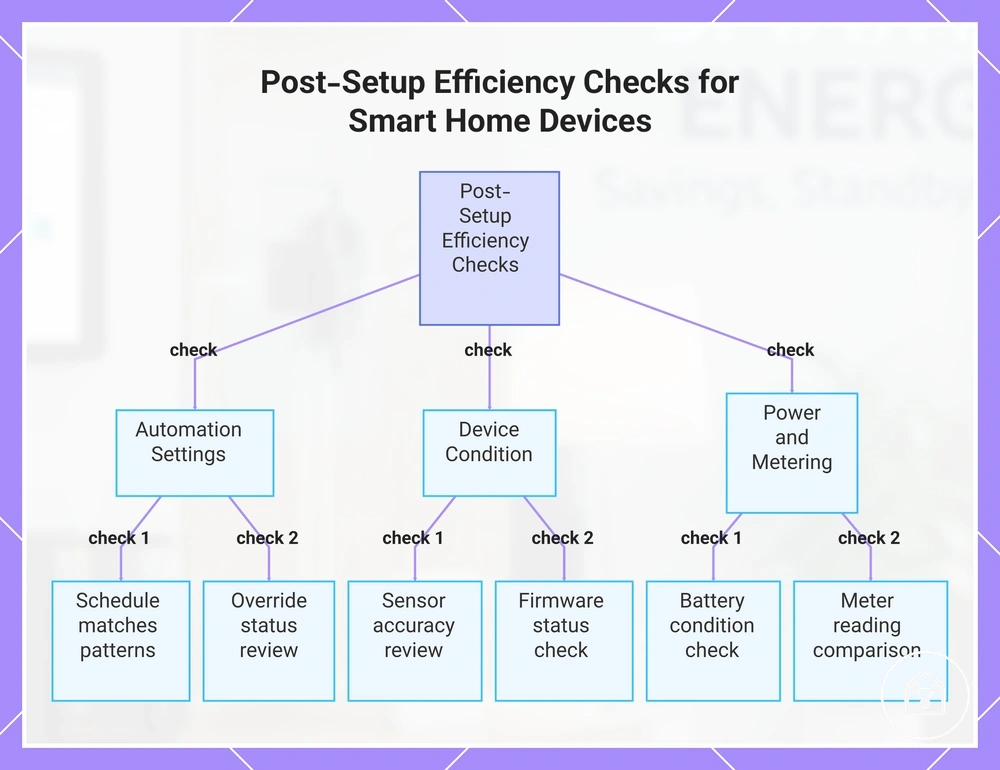
Efficiency Checks After Setup
Efficiency checks after setup verify whether smart home devices continue supporting energy efficiency through correct operation, automation behaviour, and standby control. Ongoing verification helps identify when schedules, sensors, firmware, battery condition, meter reading, or override status no longer match the intended energy use. These checks support maintained savings by confirming that the device and automation continue operating as expected.
These checks support maintained savings by confirming that the device and automation continue operating as expected.
Schedules, overrides, and sensor accuracy are important because automation only supports efficiency when its settings and inputs reflect actual household conditions. A changed routine, inaccurate sensor reading, outdated firmware, low battery condition, or frequent manual override can reduce the intended effect and contribute to wasted use.
Schedules, overrides, and sensor accuracy are important because automation only supports efficiency when its settings and inputs reflect actual household conditions.
Efficiency checks after setup also connect with maintenance and efficiency because routine reviews help confirm that energy-related features remain aligned with their operating conditions.
Efficiency checks after setup also connect with maintenance and efficiency because routine reviews help confirm that energy-related features remain aligned with their operating conditions.
Use this checklist to verify whether smart home devices continue supporting energy goals after setup:
- Schedule: Check that automation schedules still match current usage patterns and do not create unnecessary runtime.
- Sensor accuracy: Review sensor inputs to confirm that occupancy, temperature, or other measurements continue reflecting the conditions used by automation.
- Firmware: Review firmware status to confirm that device functions and automation features continue operating correctly.
- Battery: Check battery-powered devices to confirm they maintain the operating condition needed for reliable inputs.
- Meter reading: Compare meter readings or usage information with previous patterns to identify unexpected changes in electricity use.
- Override status: Review manual overrides to identify routines that no longer reduce waste or no longer match household needs.
Practical decision signals include reviewing automations that run more often than expected, checking plugs or meters when usage patterns change, and removing routines that no longer support standby control or reduce unnecessary operation. These reviews help distinguish an effective automation condition from a routine that has become a source of wasted use.
Before buying, check that the compatibility criteria, key features, and product details match your needs.
The products below are useful examples for comparing available options. Before buying, check that the compatibility criteria, key features, and product details match your needs.
This chart shows the six key verification checks to confirm that smart home devices continue supporting energy efficiency after initial setup.