Smart Home Device Costs and Value Decisions
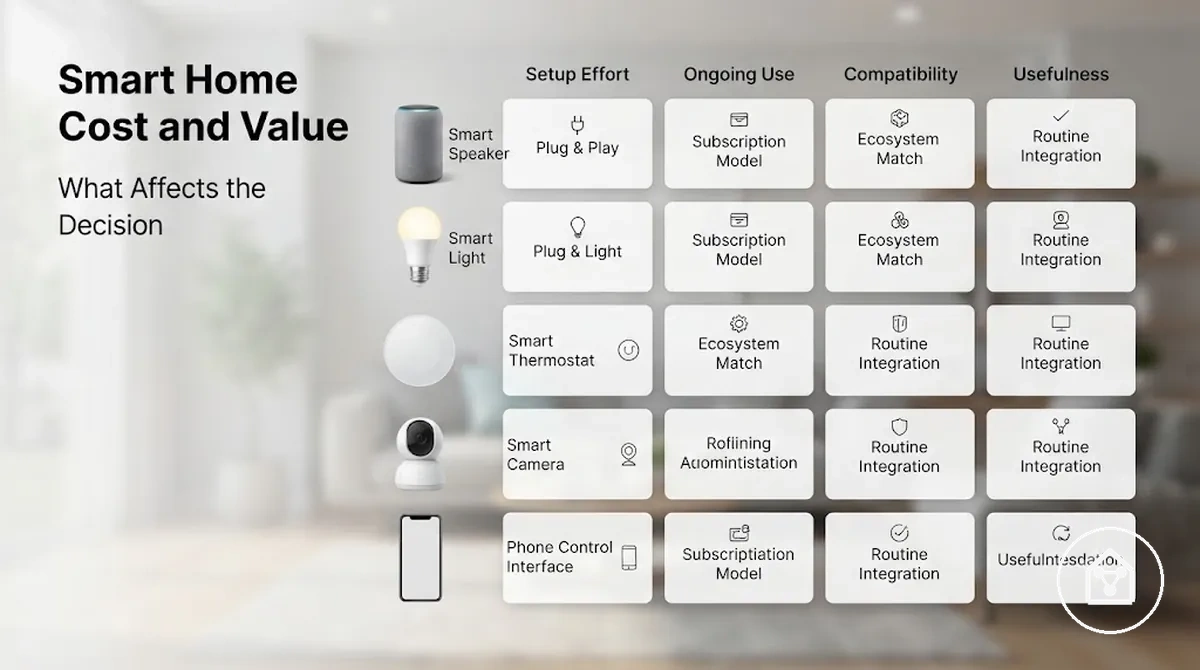
Smart home device cost is best evaluated by comparing the upfront price with the ownership value it is likely to deliver over time. That value is conditional on device type, compatibility with the existing ecosystem, daily use, running cost, maintenance needs, setup effort, and replacement risk rather than the purchase price alone.
For broader context, see the smart home devices overview .
Cost includes both the initial purchase and the ongoing ownership cost. Ownership cost can include accessories, batteries, subscriptions, energy use, maintenance, and time spent on setup or future replacement. This page evaluates these value factors rather than acting as a seller or product catalogue. For broader context, see the smart home devices overview.
Cost includes both the initial purchase and the ongoing ownership cost.
A single smart home device, such as a smart plug, often has fewer ownership considerations than a connected multi-device system that may require a compatible hub, coordinated apps, or additional accessories. For example, a device with a higher upfront price could represent better long-term value if it integrates with an existing smart home ecosystem and avoids the cost of additional hardware or subscription services. These comparisons establish the cost components examined throughout the rest of the page.
These comparisons establish the cost components examined throughout the rest of the page.
Long-term value should be judged by balancing purchase price against expected usefulness, compatibility, running cost, maintenance requirements, and replacement risk across the intended ownership period. The following sections qualify these decision factors by use case and system fit instead of promising universal savings or fixed payback outcomes.
Table of Contents
What Smart Home Device Cost Includes
Smart home device cost includes both the purchase price and the supporting costs required to make the device work as intended. The purchase boundary extends beyond the hardware when supporting components or services are needed. The main cost categories are hardware cost, hub, sensors, switches, accessories, app requirements, setup effort, installation cost, and replacement.
The purchase boundary extends beyond the hardware when supporting components or services are needed.
What Smart Home Device Cost Includes is easier to evaluate when each cost component is separated before comparing overall value. The illustration below identifies the primary cost elements and shows how each can influence a purchasing decision without presenting products as a catalogue.
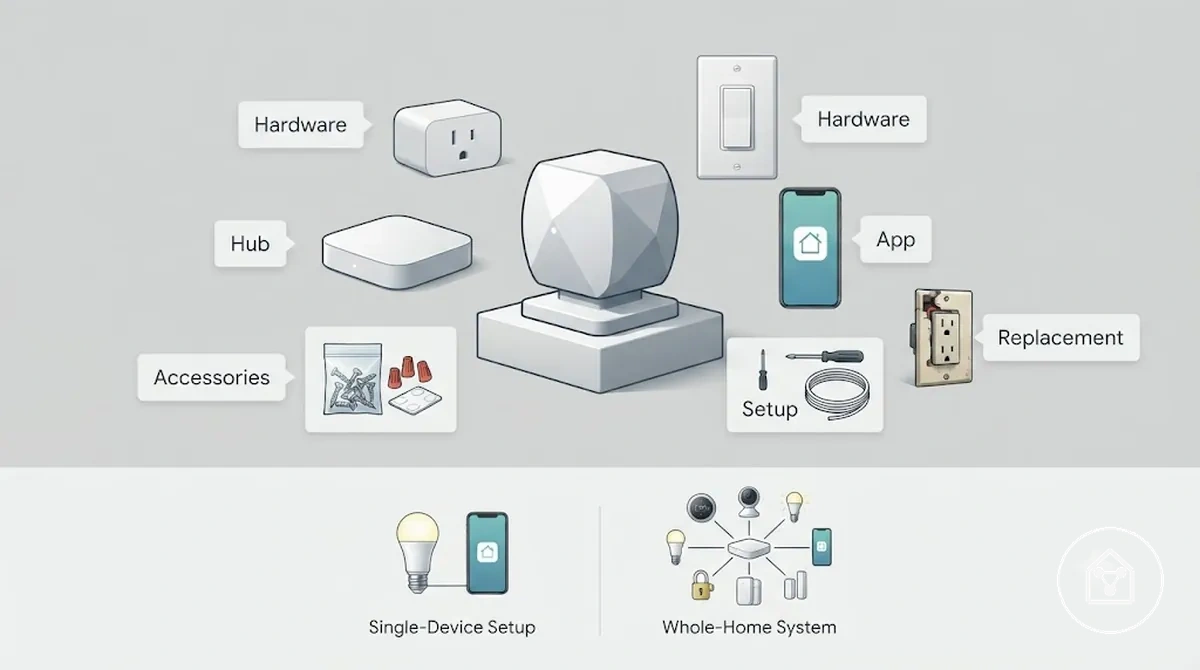
A single-device purchase commonly includes only the device hardware and basic setup, while a multi-room system can require additional hubs, sensors, switches, accessories, or installation work. App requirements or subscriptions become part of the purchase boundary only when the selected ecosystem or features require them because they support device operation rather than the hardware itself. For example, a standalone smart plug may operate directly through Wi-Fi, whereas a whole-home automation system may require a dedicated hub to connect multiple devices. The following table organizes these cost components by their effect on purchasing decisions.
| Cost element | When it appears | Why it affects value |
|---|---|---|
| Hardware | Included with every smart home device purchase | Represents the essential upfront hardware cost. |
| Hub or bridge | Required only when the chosen ecosystem depends on one | Adds supporting system cost while enabling compatible devices to communicate. |
| Accessories | Needed for mounting, expansion, or connectivity | Increase the initial purchase boundary and improve system completeness. |
| App or subscription | Only when required by the provider or selected features | Adds supporting cost beyond the hardware purchase. |
| Setup | When configuration or installation extends beyond basic self-setup | Adds setup effort or installation cost before the system is ready to use. |
| Replacement | When components wear out, become obsolete, or the system expands | Influences future purchasing decisions without covering ongoing running costs. |
Counting only the purchase price can understate the real purchase boundary when supporting components are required. Reviewing both the upfront hardware cost and supporting costs before choosing a system helps produce a more accurate cost-value comparison. This provides a clearer basis for comparing smart home device options without relying on exact totals or promotional pricing.
Individual Devices, Kits, and Whole-Home Systems
The purchase unit changes the real cost boundary because an individual device, a starter kit, and a whole-home system include different amounts of hardware, room coverage, and expansion potential. An individual device addresses a focused need, a starter kit combines essential components, and a whole-home system extends automation across multiple control points. These three purchase units create different cost expectations.
These three purchase units create different cost expectations.
Individual Devices, Kits, and Whole-Home Systems become easier to compare when the purchase boundary is separated from the intended level of coverage. The illustration below highlights how each purchase unit differs by device count, room coverage, and upgrade path.
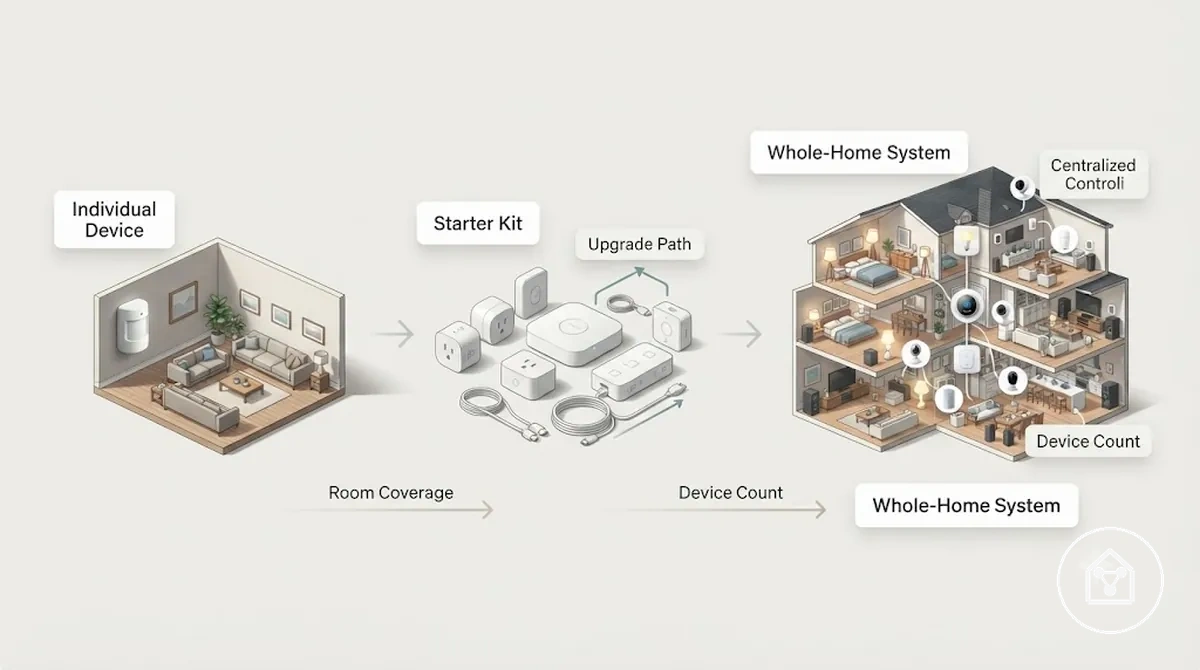
A single device usually covers one control point with limited room coverage and low setup effort. A starter kit adds bundled accessories and provides an upgrade path for future expansion, while a whole-home system increases device count to automate multiple rooms and control points. For example, one smart sensor may suit a single entrance, whereas a starter kit can extend coverage to several connected areas before expanding into a multi-room setup. The comparison below clarifies how the purchase unit changes the cost boundary rather than indicating that one option offers better value than another.
| Purchase unit | Cost boundary | Best-fit condition |
|---|---|---|
| Individual device | Single device, limited room coverage, low setup effort | Targeting one specific automation need |
| Starter kit | Bundled accessories with a defined upgrade path | Building an expandable connected setup |
| Whole-home system | Higher device count across multiple rooms and control points | Coordinating automation throughout a larger property |
Choosing bundled accessories that are unlikely to be installed can increase the purchase boundary without improving practical value. Matching the purchase unit to the intended room coverage and planned upgrade path helps avoid unnecessary spending while keeping future expansion possible.
Hardware, Hub, App, and Accessory Costs
Support parts can change the total cost of a smart home purchase because they extend the system beyond the main device. Hardware, hubs, bridges, app tiers, sensors, mounts, power adapters, and accessory packs each add a different cost effect depending on the chosen setup. These support parts should be considered separately from the main device price.
These support parts should be considered separately from the main device price.
Hardware, Hub, App, and Accessory Costs become easier to assess when supporting components are separated from the primary purchase.
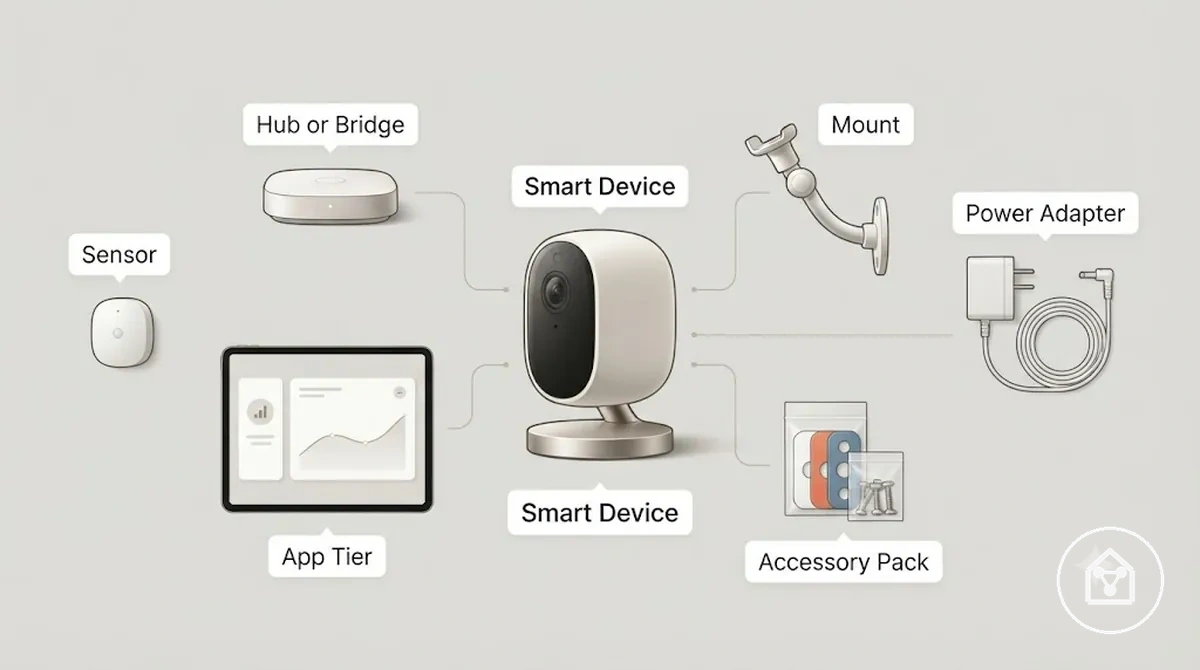
Small add-ons can noticeably affect the overall investment as a smart home expands because each extra component supports a different function. For example, a single smart device may operate without additional hardware, while a larger setup could require a hub, extra sensors, mounting accessories, or an upgraded app tier. The list below separates common support costs from the main device purchase.
- Hardware: Extra hardware increases total cost when additional controllers or supporting components are needed to complete the intended setup.
- Hub or bridge: A hub or bridge adds cost only when compatible devices require a dedicated gateway for communication and central control.
- App tier or subscription: An app tier or subscription can introduce recurring costs when a provider limits advanced automation, cloud storage, or premium features to a paid plan.
- Sensor: Additional sensors expand monitoring or automation coverage, increasing both system capability and the total purchase cost.
- Mount and power adapter: Mounts and power adapters may be required for secure installation or reliable power when they are not included with the device package.
- Accessory pack: An accessory pack groups supporting components for future expansion, but it increases the purchase boundary because some included items may not be needed immediately.
Setup, Installation, and Integration Costs
Setup effort, installation cost, and integration complexity can increase the total ownership cost when a smart home system becomes more complex than a standalone device. The main cost conditions are DIY setup, professional installation, wiring needs, app pairing, hub integration, and multi-device coordination.
Setup, Installation, and Integration Costs become easier to evaluate when setup requirements are separated from the purchase price.
Setup, Installation, and Integration Costs become easier to evaluate when setup requirements are separated from the purchase price.
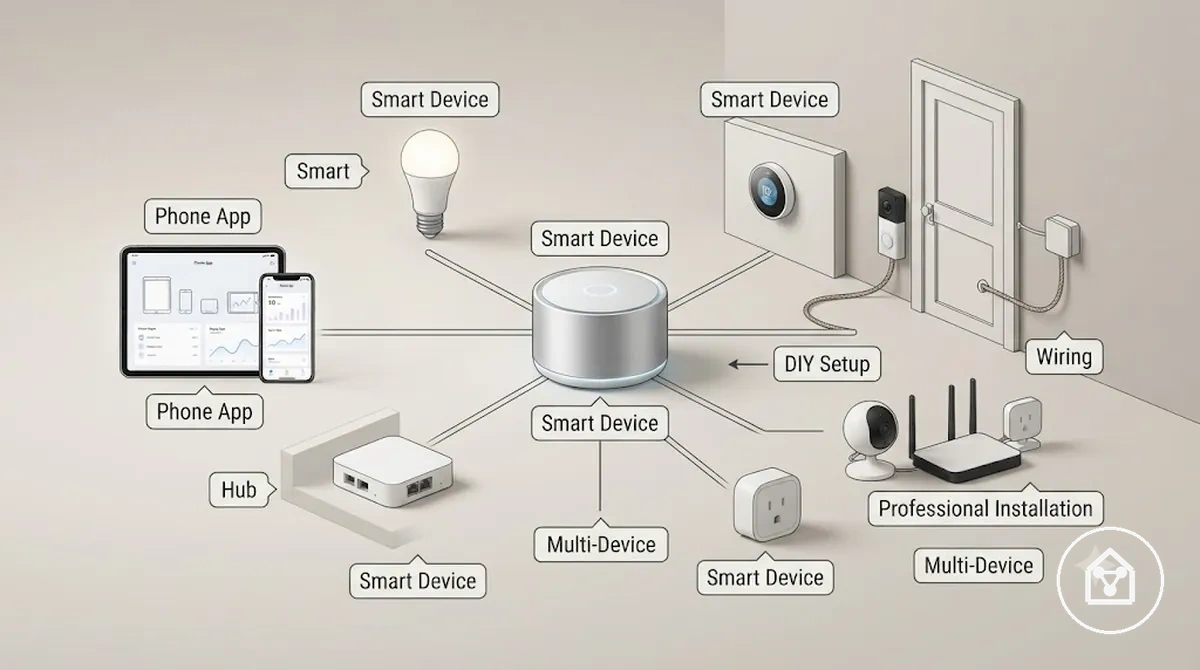
DIY setup is often appropriate for devices that use simple app pairing and do not require additional wiring or hub integration. Professional installation can become a cost factor when wiring needs, complex system integration, or multi-device coordination increase the setup effort. For example, installing a single smart plug typically requires less setup support than coordinating smart lighting, sensors, and a central hub across multiple rooms. This section considers setup cost only as a value factor rather than a complete installation workflow.
This section considers setup cost only as a value factor rather than a complete installation workflow.
The checklist below helps identify conditions that can increase setup and integration costs without describing installation procedures.
- Hub integration is needed to connect multiple compatible devices through a central controller.
- Wiring needs extend beyond the existing installation and increase setup effort.
- App pairing must be completed across multiple devices, users, or automation groups.
- Multi-device coordination is required so automations operate together throughout the system.
- Professional installation becomes a reasonable option because integration complexity exceeds a straightforward DIY setup.
Price Factors That Change Smart Home Value
Price factors change smart home value when they improve fit, coverage, reliability, or reduce ownership risk rather than merely increasing purchase price. The main criteria are home size, room coverage, device category, feature depth, ecosystem fit, support horizon, and replacement risk.
Comparing each factor, value condition, and decision signal makes that difference explicit.
Two similarly priced devices can deliver different value because their attributes suit different conditions. For example, a device that covers the required rooms and works with an existing ecosystem can provide greater practical value than one with deeper features that remain unused. Comparing each factor, value condition, and decision signal makes that difference explicit.
Two similarly priced devices can deliver different value because their attributes suit different conditions.
A higher price is justified only when it reduces friction, improves compatibility, supports longer useful life, or lowers replacement risk for the intended situation. Apply the price-factor criteria first, then choose by value and need before comparing cheaper and premium options.
Apply the price-factor criteria first, then choose by value and need before comparing cheaper and premium options.
Price Factors That Change Smart Home Value: The table links each factor to a clear condition, consequence, and decision signal.
| Factor | Value condition | Why it changes value | Decision signal |
|---|---|---|---|
| Coverage | Coverage matches the home size and required room count. | Correct coverage improves usefulness and avoids buying duplicate devices for uncovered areas. | Pay more for broader coverage only when the intended rooms require it. |
| Device category | The device category matches the primary task. | A suitable category concentrates cost on the function the household will use. | Choose the category that resolves the main need rather than one with unrelated capabilities. |
| Feature depth | Advanced features support regular daily use. | Feature depth adds value when the added controls or automation remain useful after setup. | Accept a higher price only for features that will be used consistently. |
| Ecosystem fit | The device uses a compatible ecosystem, platform, or control method already present in the home. | Strong ecosystem fit reduces integration friction and the risk of replacing otherwise functional devices. | Prefer the option that connects with the existing setup without requiring avoidable system changes. |
| Support horizon | The expected update and product-support period aligns with the planned ownership period. | A longer support horizon can preserve compatibility, reliability, and useful features for longer. | A higher price is more reasonable when the documented support period better matches long-term use. |
| Replacement risk | The device is less likely to become unsuitable because of limited compatibility, support, or capacity. | Lower replacement risk reduces the chance of repeat spending before the device reaches the end of its useful life. | Consider a higher initial price when it clearly lowers future ownership risk. |
Home Size and Room Coverage
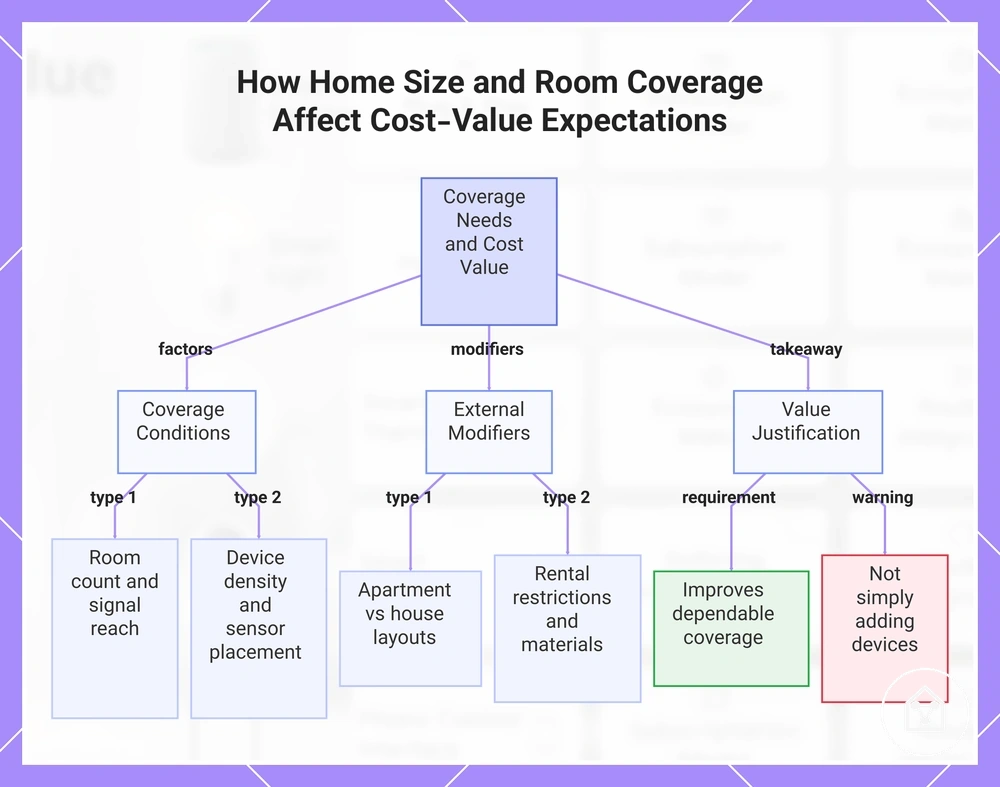
Home size and room coverage affect cost-value expectations because broader coverage needs can justify higher spending when they improve reliable control coverage and daily usefulness. The main coverage conditions are room count, signal reach, device density, sensor placement, and control coverage, while apartment layouts, houses, rental restrictions, and building materials can change how much coverage is appropriate.
As room count and coverage area increase, extra cost is more likely to represent good value when it improves dependable coverage instead of simply adding more devices.
For example, a single-room setup in an apartment may achieve suitable control coverage with fewer devices, whereas a house with multiple rooms can require greater signal reach, additional sensor placement, and higher device density if walls or floors reduce wireless reliability. As room count and coverage area increase, extra cost is more likely to represent good value when it improves dependable coverage instead of simply adding more devices.
This chart shows how home size and room coverage influence cost-value expectations through coverage conditions, external factors, and the key takeaway that cost is justified by improved dependable coverage.
This chart shows how home size and room coverage influence cost-value expectations through coverage conditions, external factors, and the key takeaway that cost is justified by improved dependable coverage.
Device Category and Feature Depth
Device category and feature depth determine how much practical value a price can deliver because each category serves a different use case and each feature set changes everyday usefulness. Feature depth should match the job the device must perform, with the main value-relevant categories including lighting, plugs, sensors, switches, hubs, and security-related devices.
Compare useful feature depth with unnecessary extras before paying more, because the best fit depends on how the device will be used each day.
For example, a basic smart plug can provide good value when scheduled power control is the only goal, while added monitoring features become worthwhile only if energy information is reviewed and used. Compare useful feature depth with unnecessary extras before paying more, because the best fit depends on how the device will be used each day.
| Category | Useful feature depth | Cost-value caution |
|---|---|---|
| Lighting | Dimming, scheduling, and smart controls used in daily routines. | Advanced controls add limited value when simple on/off control is sufficient. |
| Plugs | Automation support and monitoring features for devices used regularly. | Extra monitoring features increase cost if the information is rarely used. |
| Sensors | Reliable detection that supports useful automations. | Additional sensing functions are worthwhile only when they trigger meaningful actions. |
| Switches | Flexible control that matches everyday operation. | Complex smart controls can become unnecessary cost when manual control is adequate. |
| Hubs | Automation support across multiple compatible devices. | A hub provides better value when coordinating several devices rather than a single one. |
| Security-related devices | Monitoring features that improve awareness of important events. | Pay more for advanced features only when they support the intended level of monitoring and daily use. |
Ecosystem Fit and Compatibility Risk
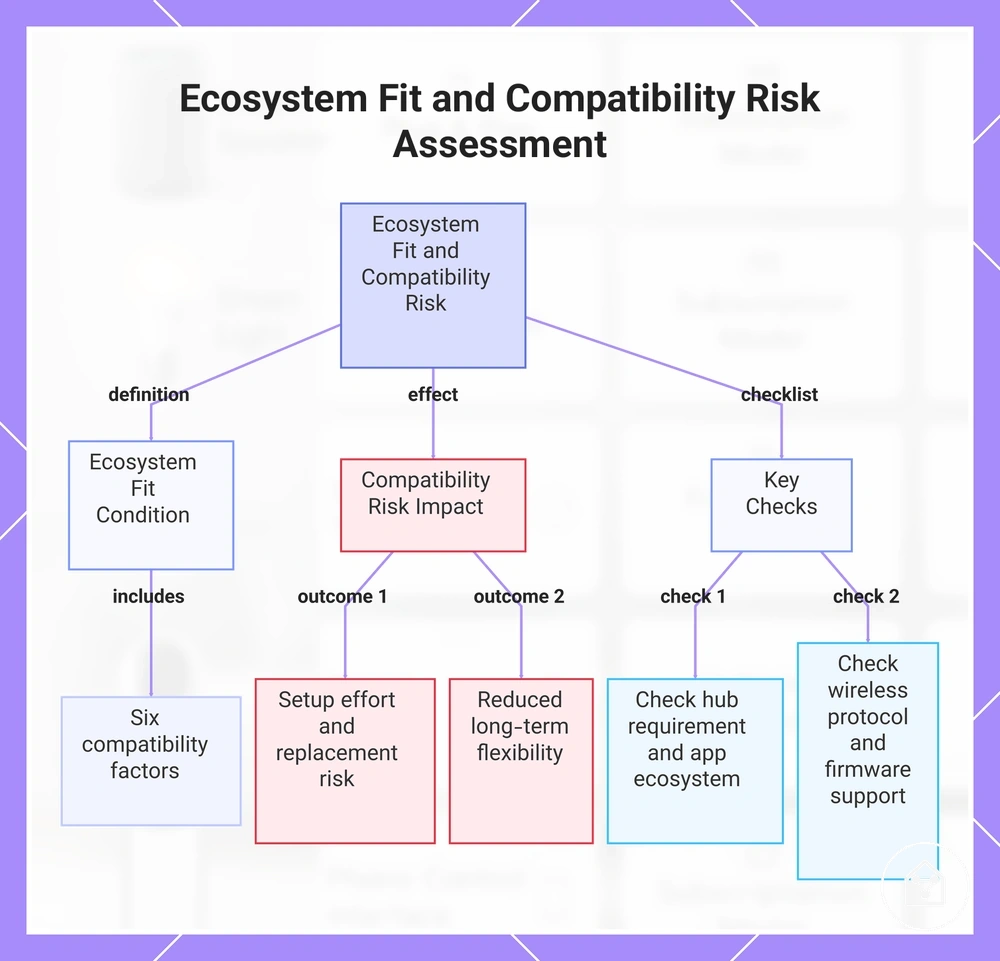
Ecosystem fit is suitable when the device matches the existing app ecosystem, hub requirement, wireless protocol, voice assistant support, firmware support, and cross-device automation needs. Compatibility risk changes real value by increasing setup effort, replacement risk, or reducing long-term flexibility when those conditions do not align.
Ecosystem Fit and Compatibility Risk should be checked as a cost-value condition before comparing purchase prices.
Ecosystem Fit and Compatibility Risk should be checked as a cost-value condition before comparing purchase prices.
- Confirm that the app ecosystem matches the platform already used; changing platforms later can increase replacement risk.
- Check the hub requirement; a separate hub adds hardware cost, while an existing compatible hub avoids that extra expense.
- Verify the wireless protocol; a matching protocol supports integration, while a mismatch can increase setup effort or require additional equipment.
- Review voice assistant support only when voice control is part of daily use; unsupported or unused voice features provide limited ownership value.
- Check firmware support; continued manufacturer updates support longer-term reliability, while discontinued support increases replacement risk.
- Assess cross-device automation; compatibility with existing routines can improve daily usefulness, while isolated operation reduces the value of advanced automation features.
For example, a cheaper device can become more costly when it requires a separate hub or forces the replacement of devices that already work together. The lower purchase price offers better value only when the device fits the current system without creating extra hardware costs, setup effort, or reduced flexibility. This subsection treats compatibility as a cost and value risk rather than the complete compatibility decision process.
This subsection treats compatibility as a cost and value risk rather than the complete compatibility decision process.
This chart shows how to evaluate ecosystem fit and compatibility risk as a cost-value condition before comparing purchase prices.
Cheap vs Premium Smart Home Devices
Cheap smart home devices and premium smart home devices create different value trade-offs: lower-cost devices suit narrow needs when their fit, reliability, support, and daily usefulness are sufficient, while premium devices justify a higher upfront price only when deeper features or lower ownership risk provide practical value. The comparison should therefore cover upfront price, feature depth, build quality, app stability, ecosystem support, warranty expectations, and replacement risk.
The table below compares these conditions directly.
For basic automation, such as controlling a single light or plug, a lower-cost device can be the stronger fit when it performs the required task without adding unnecessary hardware or replacement pressure. A longer-term connected system places greater value on app stability, ecosystem support, cross-device operation, and ownership confidence because weaknesses in those areas can affect multiple devices. The table below compares these conditions directly.
| Dimension | Lower-cost device | Premium device | Value decision |
|---|---|---|---|
| Upfront price | A lower upfront price supports a narrow need or limited deployment. | A higher upfront price requires benefits that remain useful during ownership. | Choose the lower-cost option when the task is simple; pay more only when added capability reduces another cost or limitation. |
| Feature depth | A focused feature set can satisfy basic automation without unused functions. | Broader feature depth can support more complex routines and connected-system use. | Extra features add value only when they improve daily usefulness. |
| App stability | A basic app is sufficient when control remains dependable for the intended task. | A more stable app has greater value when frequent control or multiple devices rely on it. | Prioritise app stability when unreliable control would disrupt regular use or prompt replacement. |
| Ecosystem support | Limited ecosystem support can be acceptable when the device operates independently. | Broader ecosystem support can improve integration and long-term flexibility across a connected system. | Choose broader support when cross-device operation is part of the intended setup. |
| Reliability and build quality | Basic build quality can be adequate for light use or an easily replaced device. | Stronger build quality can justify the premium for frequent use or harder-to-replace locations. | Match reliability expectations to usage frequency and the consequence of failure. |
| Warranty expectations | Limited warranty coverage can be acceptable when replacement cost and disruption are low. | Stronger warranty expectations can improve ownership confidence for a higher-priced or system-critical device. | Warranty coverage adds value when it reduces a meaningful financial or replacement risk. |
| Replacement risk | A low purchase price loses value when weak support or poor system fit causes earlier replacement. | A higher purchase price can provide longer-term value when support and compatibility reduce replacement pressure. | Compare ownership risk rather than treating purchase price as the complete cost. |
Price alone does not prove that premium smart home devices are higher quality or that cheap smart home devices are poor value. Use these local trade-offs to compare smart home devices across the same criteria. A lower-cost device is the stronger decision for a stable, narrow requirement, while a premium option is justified when its feature depth, app stability, ecosystem support, build quality, or warranty expectations reduce a specific ownership risk.
When Lower-Cost Devices Are Enough
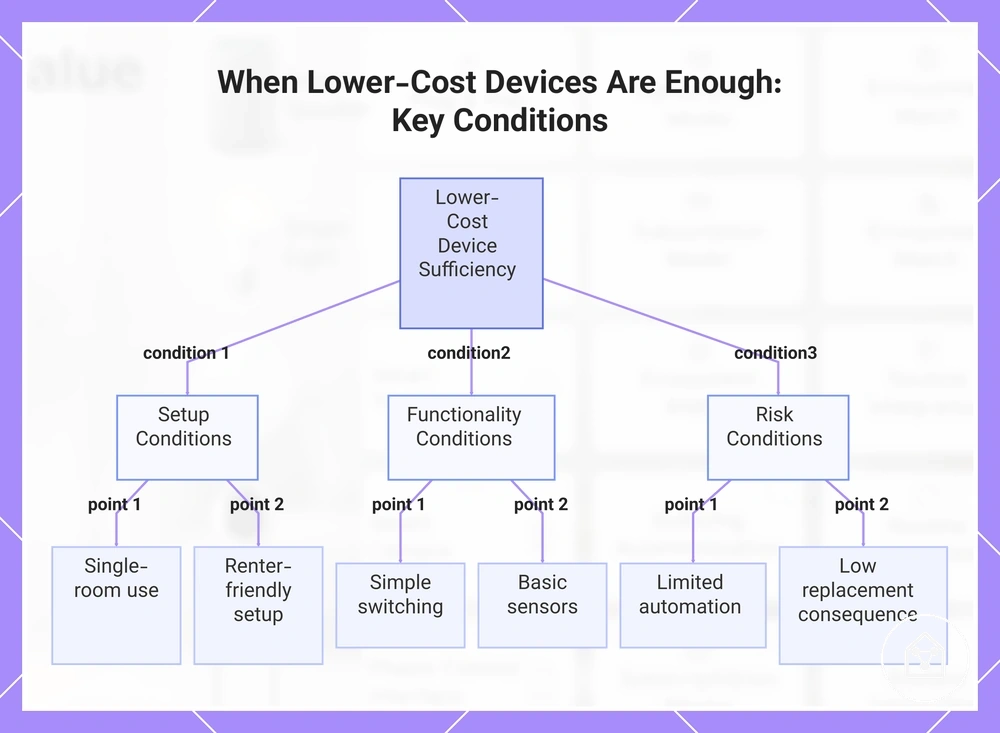
Lower-cost devices are enough when task simplicity is high and integration risk is low. They can provide sufficient value for a narrow daily need when the setup involves single-room use, simple switching, basic sensors, limited automation, or a low replacement consequence.
The following conditions indicate when a lower-cost device is likely to be sufficient.
For example, a renter who needs one plug-controlled lamp in a single room may not benefit from deeper ecosystem features when the device performs only that isolated task. In this low-risk use case, the decision rests on whether the device completes the required function without creating installation, compatibility, or replacement problems. The following conditions indicate when a lower-cost device is likely to be sufficient.
- Single-room use: A lower-cost device is enough when its function is confined to one room and does not need to coordinate with a wider connected system.
- Simple switching: A basic device provides enough value when the required outcome is limited to dependable on-and-off control rather than advanced routines or detailed monitoring.
- Basic sensors: Lower-cost devices suit simple detection tasks when the sensor triggers one defined action and broader automation is not required.
- Renter-friendly setup: A lower-cost device can be appropriate when the installation is removable, avoids permanent changes, and matches the permitted setup.
- Limited automation: A lower-cost device can satisfy the need when automation is restricted to simple schedules or isolated triggers rather than cross-device routines.
- Low replacement consequence: A lower-cost device remains a sound decision when failure would cause limited disruption and replacement would not affect other devices or automations.
This chart shows the main conditions that indicate when a lower-cost smart home device is sufficient for a task.
When Premium Devices Create Better Long-Term Value
Premium devices create long-term value only when the higher purchase price reduces ongoing friction, replacement risk, or ownership cost. A premium option is justified when ecosystem support, sensor quality, automation reliability, update support, build quality, or multi-room scaling delivers a practical benefit that remains useful throughout ownership.
Use the checklist below to confirm whether the higher price meets that threshold.
A higher price is not proof of better value, and brand status should not determine the decision. Premium devices create better long-term value only when their additional capabilities improve daily use, reduce maintenance effort, or lower replacement risk compared with a lower-cost alternative serving the same purpose. Use the checklist below to confirm whether the higher price meets that threshold.
- Ecosystem support: Choose a premium device when broader platform compatibility reduces friction across multiple connected devices.
- Sensor quality: A higher-priced device is justified when more consistent sensing improves automation reliability for everyday tasks.
- Automation reliability: Paying more can provide long-term value when dependable routine execution reduces repeated manual intervention.
- Update support: A premium device is worthwhile when ongoing software support helps maintain compatibility and lowers replacement risk over time.
- Build quality: Additional cost is justified when stronger construction improves ownership confidence in frequent daily use.
- Multi-room scaling: A premium option creates better long-term value when future expansion across multiple rooms can occur without adding unnecessary integration friction.
Smart Home Bundles and Starter Kit Value
Smart home bundles and starter kits improve value only when the included devices match real home needs, work with the intended ecosystem, and avoid unused items. A smart home bundle becomes less cost-effective when duplicate devices, unnecessary accessories, or weak upgrade compatibility add cost without adding useful function.
The comparison below shows how inclusion, usefulness, and compatibility affect bundle value.
For a first-time buyer, a starter kit or hub kit can provide a practical starter setup when every included device has an immediate purpose and uses the same compatible system. A user expanding an existing system should compare each included device with current equipment and the planned upgrade path before choosing a sensor pack, plug multi-pack, or switch pack. For example, a sensor pack creates value when each sensor has a planned room or task, but extra sensors kept unused increase waste. The comparison below shows how inclusion, usefulness, and compatibility affect bundle value.
| Bundle type | Value condition | Waste risk | Best-fit situation |
|---|---|---|---|
| Starter kit | Every included device supports the initial setup and will be used. | Unused accessories or duplicate devices reduce value. | A first-time buyer creating a compatible starter setup. |
| Sensor pack | Each sensor has a planned location and monitoring purpose. | Extra sensors without a real home need become unused items. | Expanding sensing across multiple rooms or entry points. |
| Plug multi-pack | Each plug is assigned to an appliance that requires smart control. | Unassigned plugs increase cost without adding daily usefulness. | Automating multiple compatible appliances. |
| Switch pack | Every switch matches the installation requirements and planned rooms. | Surplus switches or incompatible wiring needs create waste. | Upgrading several compatible lighting controls. |
| Hub kit | The hub supports current devices and the intended upgrade path. | A duplicate hub or limited upgrade compatibility increases unnecessary cost. | Starting a new ecosystem or expanding one that requires the included hub. |
Unused items and duplicate devices reduce bundle value because they add purchase cost without extending the useful system. The practical solution is to assign a purpose to every included device and confirm compatibility with both the current setup and planned upgrades. A smart home bundle provides better value only when the used items would otherwise be needed separately and the kit does not create avoidable waste.
What a Useful Starter Kit Should Include
A useful starter kit provides value when it matches the first automation or monitoring job instead of including the largest number of devices. Its usefulness is determined by the control method, practical devices, compatible sensors, app support, and room-level usefulness. The first decision should focus on the specific task the starter kit is expected to perform.
The first decision should focus on the specific task the starter kit is expected to perform.
For example, a household beginning with lighting automation benefits from a starter setup centred on compatible lighting controls and clear app support, while a home focused on security monitoring benefits more from compatible sensors that serve that monitoring job. Because user needs and ecosystems differ, the same first kit is not suitable for every situation. Use the checklist below to confirm that each inclusion supports the intended first automation or monitoring job.
- Control method: Verify that the chosen control method matches the intended ecosystem because it determines how the starter devices are managed.
- Practical devices: Check that each included device has an immediate purpose so the kit delivers useful function instead of unused equipment.
- Compatible sensors: Confirm that included sensors support the planned monitoring job and work with the selected ecosystem.
- App support: Ensure the companion app provides the controls needed for everyday setup, automation, and monitoring.
- Room-level usefulness: Choose starter devices that solve a practical need in the room where the first automation or monitoring task will be used.
When Bundles Save Money or Create Waste
Bundle savings occur only when the included items have a planned use, not simply because the package advertises a listed discount. Bundle waste occurs when duplicate devices, unused accessories, incompatible hubs, or unnecessary replacements add cost without improving the smart home setup. Unused items reduce value even if the bundle appears less expensive than buying products separately.
The comparison below shows when bundle savings are more likely than bundle waste.
For example, a multi-pack of smart plugs creates real savings when every plug is assigned to a room and lowers the effective per-device cost across the planned installation. The same bundle creates waste if extra plugs remain unused or an incompatible hub requires replacement of existing devices. Future expansion should also be considered because a compatible system reduces replacement risk as new devices are added. The comparison below shows when bundle savings are more likely than bundle waste.
| Saves money when | Creates waste when |
|---|---|
| All used items have a planned purpose, reducing the effective per-device cost. | Duplicate devices perform jobs already covered by existing equipment. |
| A multi-pack matches the number of devices needed for the planned installation. | Unused accessories remain without a practical role. |
| The included hub is compatible with the current system and future expansion plans. | Incompatible hubs require replacing existing devices or adding unnecessary hardware. |
| The bundle reduces future purchases because every included device fits the intended setup. | Replacement risk increases when included products do not match the planned ecosystem. |
Running Costs and Long-Term Ownership
Running costs and long-term ownership influence smart home device value because recurring and delayed expenses continue after the initial purchase. Long-term ownership includes standby power, batteries, subscriptions, replacement parts, firmware support, reliability, and ongoing support, all of which affect ownership cost over time. These recurring cost categories should be considered alongside the purchase price when judging overall value.
The table below summarises how each ongoing cost influences long-term ownership value.
Recurring costs often appear small for a single device but become more noticeable across a larger smart home. Standby power is typically a minor ongoing cost, while batteries, subscriptions, and replacement parts can have a greater effect depending on usage frequency and the chosen features. Devices with reliable firmware support are more likely to remain secure and functional for longer, reducing the likelihood of premature replacement. The table below summarises how each ongoing cost influences long-term ownership value.
A stronger purchase decision weighs both the initial price and the long-term ownership burden.
For example, a mains-powered smart plug may have a small standby power cost but could contribute to energy-saving potential if its automation reduces unnecessary appliance use. By comparison, a battery-powered sensor with frequent battery replacements and an optional cloud subscription may create a higher ongoing ownership cost. Running costs remain minor when recurring expenses stay low and firmware support continues, but they are more likely to weaken value when multiple recurring costs accumulate. A stronger purchase decision weighs both the initial price and the long-term ownership burden.
| Ongoing cost | When it matters | Value effect |
|---|---|---|
| Standby power | Devices that remain powered continuously or are used in larger smart home systems. | Usually a minor running cost but can accumulate across many devices. |
| Batteries | Battery-powered devices requiring periodic replacement. | Recurring ownership cost that increases with replacement frequency. |
| Subscriptions | Optional cloud services or premium smart features. | Adds an ongoing cost that should be balanced against the delivered benefits. |
| Replacement parts | Components that wear during normal use or require replacement. | Delayed cost that can reduce long-term value if replacements are frequent. |
| Firmware support | Devices receiving continued software updates and security patches. | Extended support can improve long-term ownership by maintaining usability and security. |
| Reliability | Products designed to operate consistently with fewer failures. | Greater reliability generally lowers replacement risk and support-related costs. |
Power Use and Energy-Saving Potential
Power use and energy-saving potential influence long-term smart home value because both depend on device type and household behaviour rather than the purchase price alone. Standby power contributes a continuing running cost, while any energy-saving potential is conditional on automation schedules, usage frequency, tariffs, smart plugs, energy monitoring, lighting control, thermostat-like control, and automation quality. These variables determine whether energy use strengthens or weakens overall ownership value.
These variables determine whether energy use strengthens or weakens overall ownership value.
Standby power is typically a small ongoing cost, but well-configured automation schedules can improve energy-saving potential by reducing unnecessary device operation. For example, smart plugs can switch appliances off when they are not needed, while energy monitoring helps identify patterns that support better automation decisions, and lighting control or thermostat-like control may reduce unnecessary energy use when aligned with household routines and local tariffs. If automation is poorly configured or devices operate more frequently than required, the value benefit is reduced even though smart features remain available. For a detailed explanation of measuring consumption and comparing operating costs, see energy use and running costs, as detailed energy calculations fall outside this cost-value section.
| Energy factor | Condition | Possible value effect |
|---|---|---|
| Standby power | Devices remain powered continuously. | Adds a small ongoing running cost. |
| Automation schedules | Schedules match household behaviour and usage frequency. | May improve energy-saving potential. |
| Smart plugs | Automation controls suitable appliances when not required. | Can reduce unnecessary power use. |
| Energy monitoring | Consumption data is reviewed and used to adjust automation. | Supports more informed energy decisions. |
| Lighting control and thermostat-like control | Automation quality matches occupancy patterns and local tariffs. | Conditional energy savings that may improve long-term value. |
Batteries, Subscriptions, and Replacement Costs
Batteries, subscription features, and replacement costs affect the true value of smart home devices when recurring costs repeat across many devices or when paid features are required for useful functions. Their effect is usually lower in small systems with infrequent maintenance and greater in larger systems with frequent battery replacement or service dependency. The main cost types are battery replacement, subscriptions, replacement sensors, adapters, and mounting materials.
The bullets below show how each condition changes value.
In homes with many sensors, cameras, or high-use devices, small maintenance costs can compound and reduce long-term ownership value. For example, a system with frequent battery replacement and multiple paid features will create a higher ongoing cost than a smaller system using longer-lasting battery types and only optional subscriptions. The bullets below show how each condition changes value.
- Batteries: Battery type affects maintenance cost because replaceable cells create an ongoing purchase requirement, while rechargeable or mains-powered devices reduce repeated battery purchases.
- Battery frequency: More frequent battery replacement increases recurring cost, especially when many devices are installed; infrequent replacement has a smaller effect on ownership value.
- Subscription features: Paid features improve value when they unlock functions the household needs, but they weaken value when the service cost continues for features that are rarely used.
- Replacement sensors: Replacement costs increase when damaged, expanded, or upgraded sensors are needed, while systems that continue operating with existing sensors avoid that added maintenance cost.
- Adapters and mounting materials: Extra adapters or mounting materials raise cost when installation, relocation, or expansion requires new hardware, but they usually create an occasional rather than continuous expense.
- Service dependency: Devices that rely on an active online service retain their full feature set only while that service remains available, so the ongoing cost should be judged against the value of the dependent features.
Reliability, Updates, and Support Lifespan
Reliability, updates, and support lifespan protect long-term value when they maintain ownership confidence and delay replacement. Devices with stable apps, continuing firmware updates, accessible manufacturer support, and available replacement parts present a lower support-related ownership risk than devices that lose these functions early. The main signals are firmware updates, app stability, manufacturer support, replacement availability, warranty expectations, and failure risk.
Broader criteria for maintenance and long-term reliability can help place these support risks in the wider ownership context.
When firmware updates stop or app stability declines, a device can become less dependable even while its hardware still operates, which can bring replacement timing forward. For example, a smart device with continuing update support and available replacement components offers stronger ownership confidence than a comparable device that loses app access and has no compatible replacement parts. Warranty expectations should be limited to the provider’s stated coverage, while support lifespan should be assessed by device category, ecosystem, and provider policy. Broader criteria for maintenance and long-term reliability can help place these support risks in the wider ownership context.
- Firmware updates: A documented update policy or an active update history indicates lower software-obsolescence risk, while an unclear or discontinued policy increases the chance of earlier replacement.
- App stability: Consistent access to core controls supports long-term value; repeated loss of access or unsupported operating-system versions reduce device usefulness.
- Manufacturer support: Current documentation, contact channels, and published support information strengthen ownership confidence, while absent support information increases uncertainty.
- Replacement availability: Available compatible sensors, accessories, or parts can extend practical use, while unavailable replacements can make a minor component failure trigger full-device replacement.
- Warranty expectations and failure risk: Warranty coverage has value only within the stated period and conditions, and a shorter support horizon or limited replacement availability increases ownership risk after that coverage ends.
Value Beyond the Purchase Price
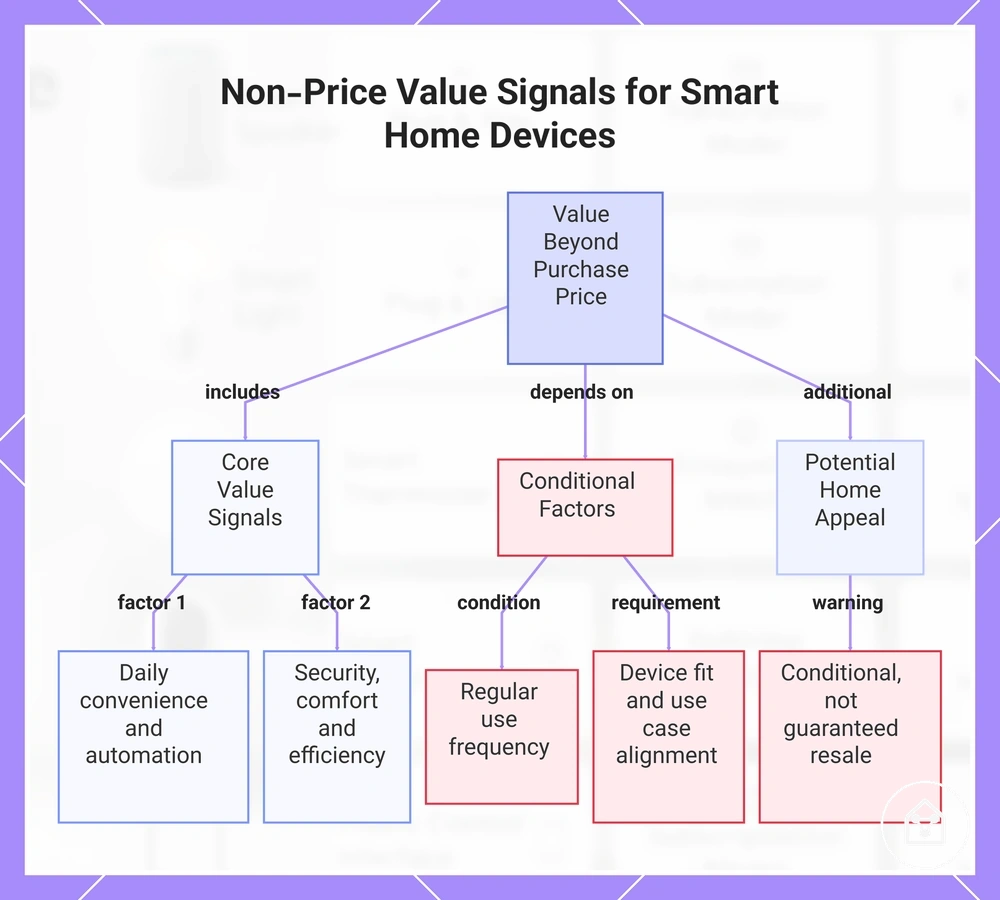
Value beyond purchase price is determined by whether a smart home device delivers practical benefit that matches its use case and device fit over time. Non-price value can justify a higher purchase price when daily convenience, automation usefulness, security relevance, comfort, efficiency, or potential home appeal provide meaningful benefits in regular use. These criteria should be considered together rather than judged by price alone.
Regular use frequency is therefore an important signal of lasting value.
A device creates stronger non-price value when it improves everyday routines through frequent, useful automation. For example, motion-activated lighting or scheduled climate control can reduce repetitive manual tasks for households that use those functions every day. If automation features are rarely used, their contribution to practical benefit becomes limited. Regular use frequency is therefore an important signal of lasting value.
These benefits remain conditional and should be assessed against the intended use case.
Security relevance, comfort, efficiency, and potential home appeal contribute to value only when they align with the household's priorities and the device fits the intended environment. For example, a connected camera can improve confidence where property monitoring is important, while a smart thermostat may improve comfort and operating efficiency in homes with predictable heating or cooling routines. Potential home appeal may matter to future occupants who appreciate connected-home features, but it should not be treated as guaranteed resale value. These benefits remain conditional and should be assessed against the intended use case.
Value beyond purchase price is strongest when a device consistently delivers usefulness that matches how it will actually be used.
Value beyond purchase price is strongest when a device consistently delivers usefulness that matches how it will actually be used. A balanced decision weighs daily convenience, automation usefulness, security relevance, comfort, efficiency, potential home appeal, and device fit before deciding whether the additional cost is justified.
The products below are useful examples for comparing available options.
The products below are useful examples for comparing available options. Before buying, check that the compatibility criteria, key features, and product details match your needs.
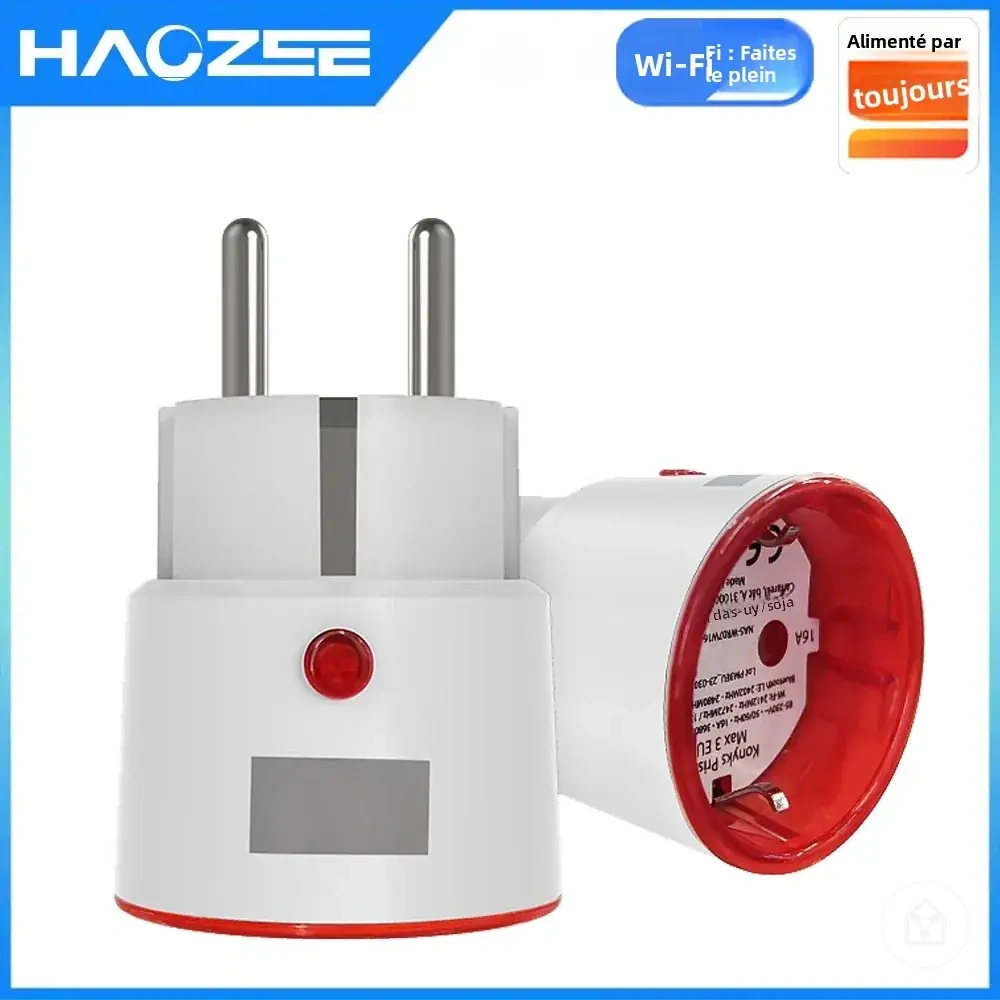
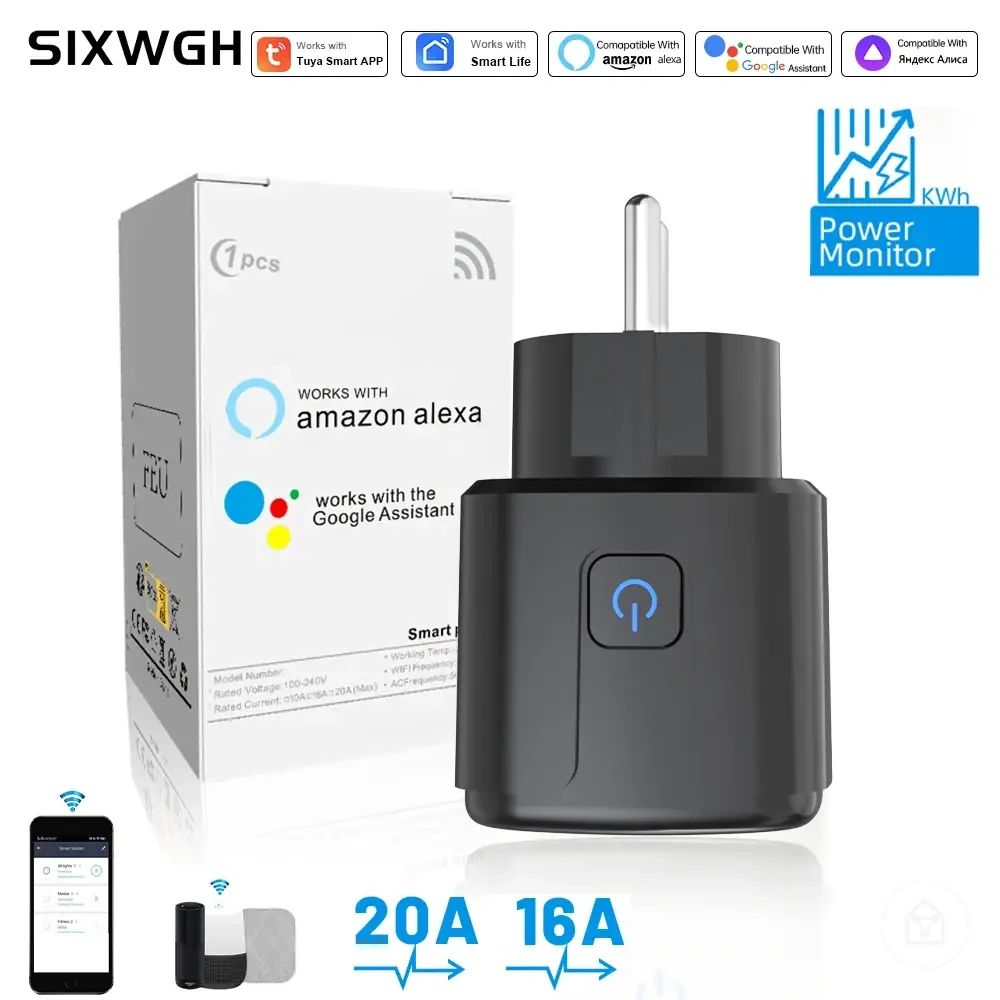
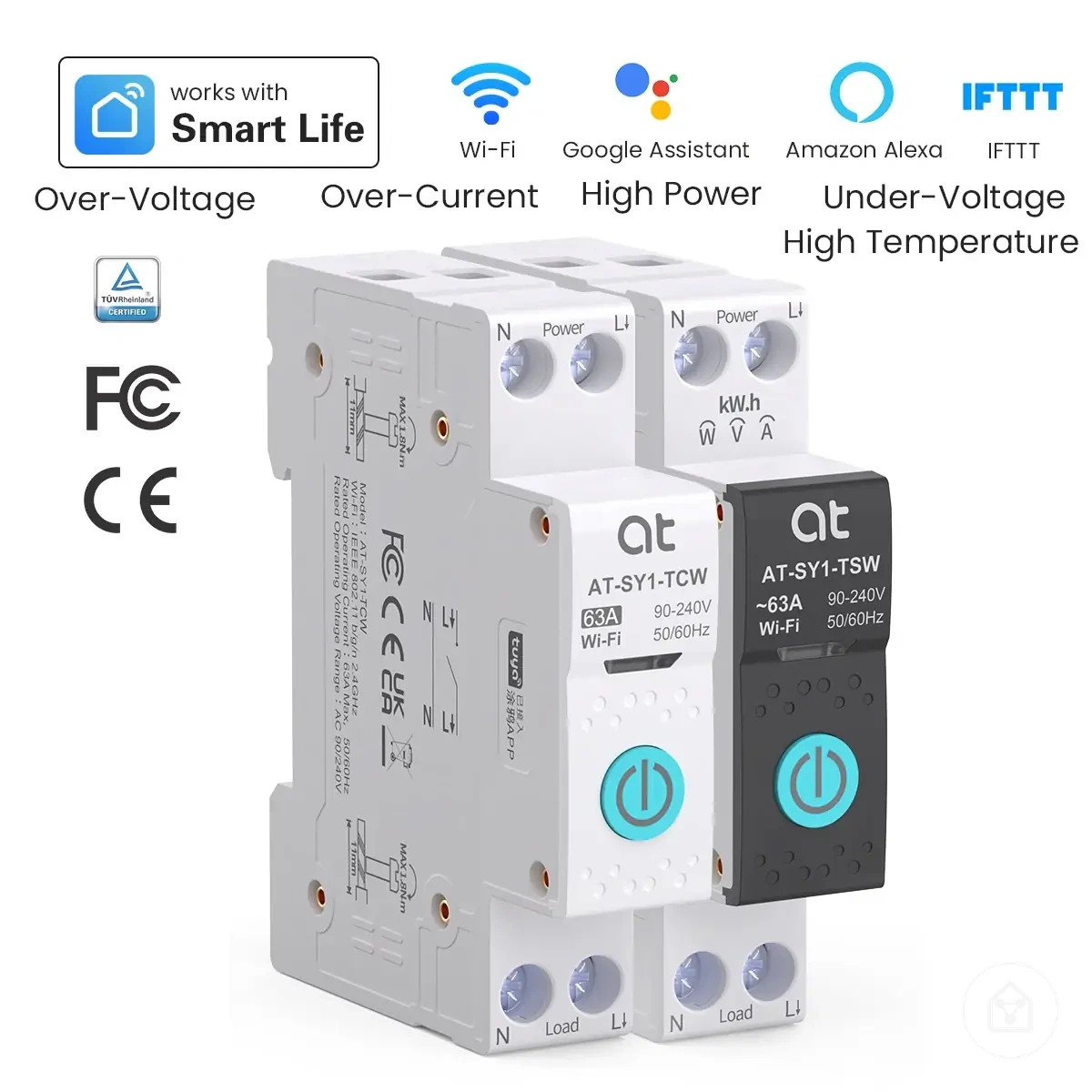
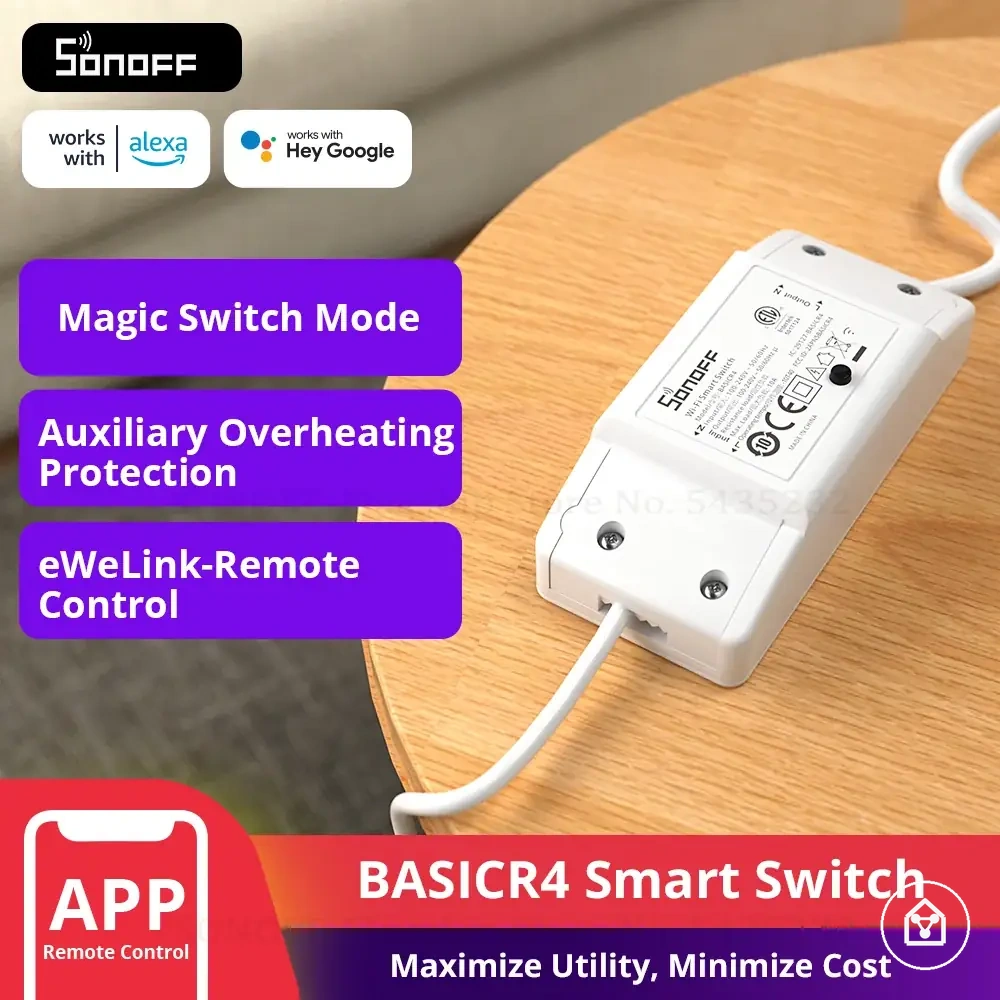
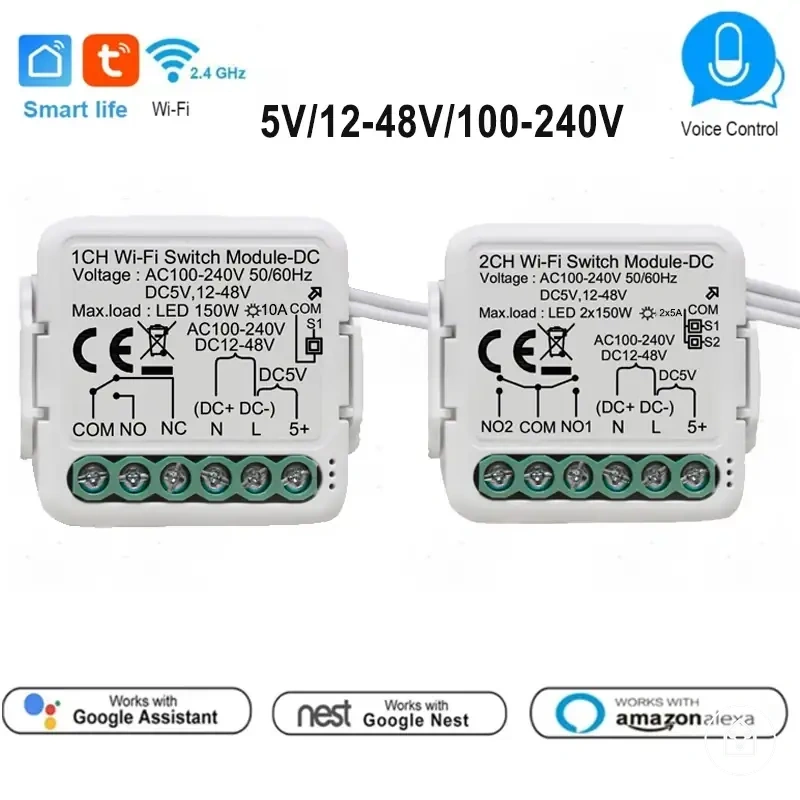
The following checklist highlights the main non-price value signals to review before making a purchase decision.
- Daily convenience: Adds value when the device regularly saves time or reduces repetitive household tasks.
- Automation usefulness: Becomes meaningful when automated routines are used consistently rather than occasionally.
- Security relevance: Improves practical benefit when monitoring or alerts address a genuine household requirement.
- Comfort and efficiency: Justify additional value when they produce noticeable day-to-day improvements for the intended use case.
- Potential home appeal: Can contribute to perceived value when future occupants appreciate smart-home features, but this benefit is conditional rather than universal.
This chart shows the main criteria and conditional factors that determine whether a smart home device delivers value beyond its purchase price.
Convenience, Security, and Daily Usefulness
Daily usefulness increases a smart home device's practical value when it consistently solves a repeated household need through convenience rather than occasional use. Convenience, security relevance, and automation reliability become more valuable when they support recurring routines, useful alerts, and reduced manual effort. The key usage variables are frequency of use, automation reliability, notification usefulness, security relevance, and the amount of manual effort the device removes.
Frequent, dependable use is therefore a stronger indicator that the device's cost translates into lasting everyday value.
A device used every day for lighting routines, access awareness, or timely alerts typically delivers greater practical value than one activated only during occasional situations. For example, automatic lighting that runs reliably each evening or notifications that confirm when someone arrives home can provide recurring convenience without making security guarantees. In contrast, a device used rarely or one with inconsistent automation reliability offers a lower daily benefit because its practical use occurs less often. Frequent, dependable use is therefore a stronger indicator that the device's cost translates into lasting everyday value.
Comfort, Efficiency, and Resale Appeal
Comfort, efficiency, and resale appeal can contribute to value beyond purchase price, but these softer value signals rarely prove cost justification on their own. Their impact depends on practical fit, device fit, compatibility, and ownership cost because the same feature can provide different value in different households. The main signals are comfort, routine consistency, perceived modernity, efficiency support, and conditional resale appeal.
Myth: Smart home devices always increase property value or pay for themselves through efficiency benefits.
Myth: Smart home devices always increase property value or pay for themselves through efficiency benefits. Truth: comfort and efficiency support can improve perceived value when they match household routines, while resale appeal remains a secondary consideration that depends on buyer preferences and market conditions. For example, automated climate settings may improve comfort for a household with consistent routines, but the benefit may be limited if the feature does not match how the home is used. Practical fit, compatibility, and ownership cost should remain the priority when evaluating these softer value factors.
Are Smart Home Devices Worth It
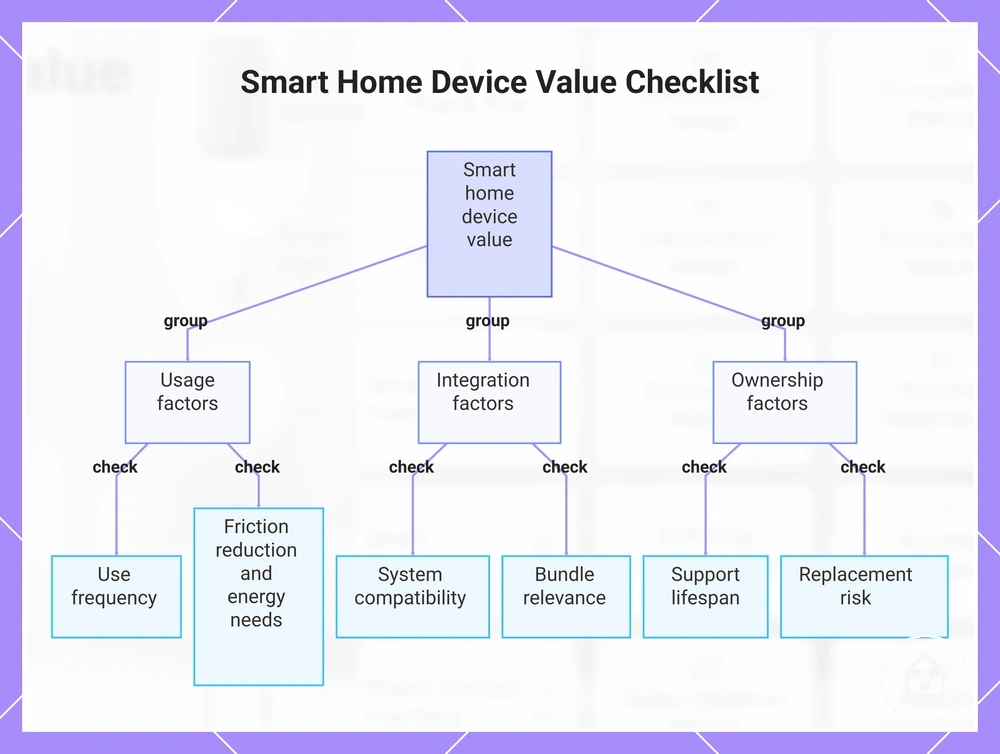
Smart home devices are worth it when their useful benefits exceed the upfront cost, running cost, compatibility risk, and maintenance burden for the intended use case. The decision is conditional because value depends on whether the device provides enough practical benefit through use frequency, system fit, avoided friction, energy or monitoring usefulness, support lifespan, bundle relevance, and replacement risk.
Strong use frequency, good system fit, and avoided friction are positive signals that the device may be worth the cost.
A high-value situation is a home where smart home devices solve repeated tasks and integrate well with existing routines. For example, frequently used lighting automation, monitoring features, or compatible connected devices can create value when they reduce manual effort and fit the household's needs. Strong use frequency, good system fit, and avoided friction are positive signals that the device may be worth the cost.
Low daily use and increased ownership friction are caution signals during the final decision.
A lower-value situation occurs when smart home devices introduce complexity without providing enough practical benefit. For example, a device with limited use frequency, higher compatibility risk, unnecessary maintenance burden, or difficult replacement requirements may create a weaker ownership trade-off. Low daily use and increased ownership friction are caution signals during the final decision.
A lower-value situation occurs when smart home devices introduce complexity without providing enough practical benefit.
The final decision should connect upfront cost with long-term ownership conditions rather than focusing on purchase price alone. Reviewing the key ownership variables through a checklist before checking prices helps verify compatibility risk, maintenance burden, support lifespan, and replacement risk before committing.
The final decision should connect upfront cost with long-term ownership conditions rather than focusing on purchase price alone.
Smart home devices are worth the cost when their useful benefits match the household's needs and remain valuable throughout ownership. The final decision should consider the balance between practical value, ownership trade-offs, and system fit rather than applying a universal yes-or-no answer.
Before buying, check that the compatibility criteria, key features, and product details match your needs.
The products below are useful examples for comparing available options. Before buying, check that the compatibility criteria, key features, and product details match your needs.
Use this final decision checklist to assess whether a smart home device is likely to provide enough value.
- Use frequency: Will the device be used often enough for its features to provide practical benefit?
- System fit: Does the device integrate with the existing setup without creating unnecessary compatibility risk?
- Avoided friction: Does the device reduce repeated effort, manual tasks, or daily inconvenience?
- Energy or monitoring usefulness: Do energy-related or monitoring features match a genuine household need?
- Support lifespan: Is the expected update support and provider policy suitable for the intended ownership period?
- Bundle relevance: Do included devices or accessories provide useful value instead of creating unused items?
- Replacement risk: Would future failures, unavailable parts, or replacements create an unacceptable ownership burden?
This chart groups the key factors to evaluate when deciding whether a smart home device provides enough practical value for your household.